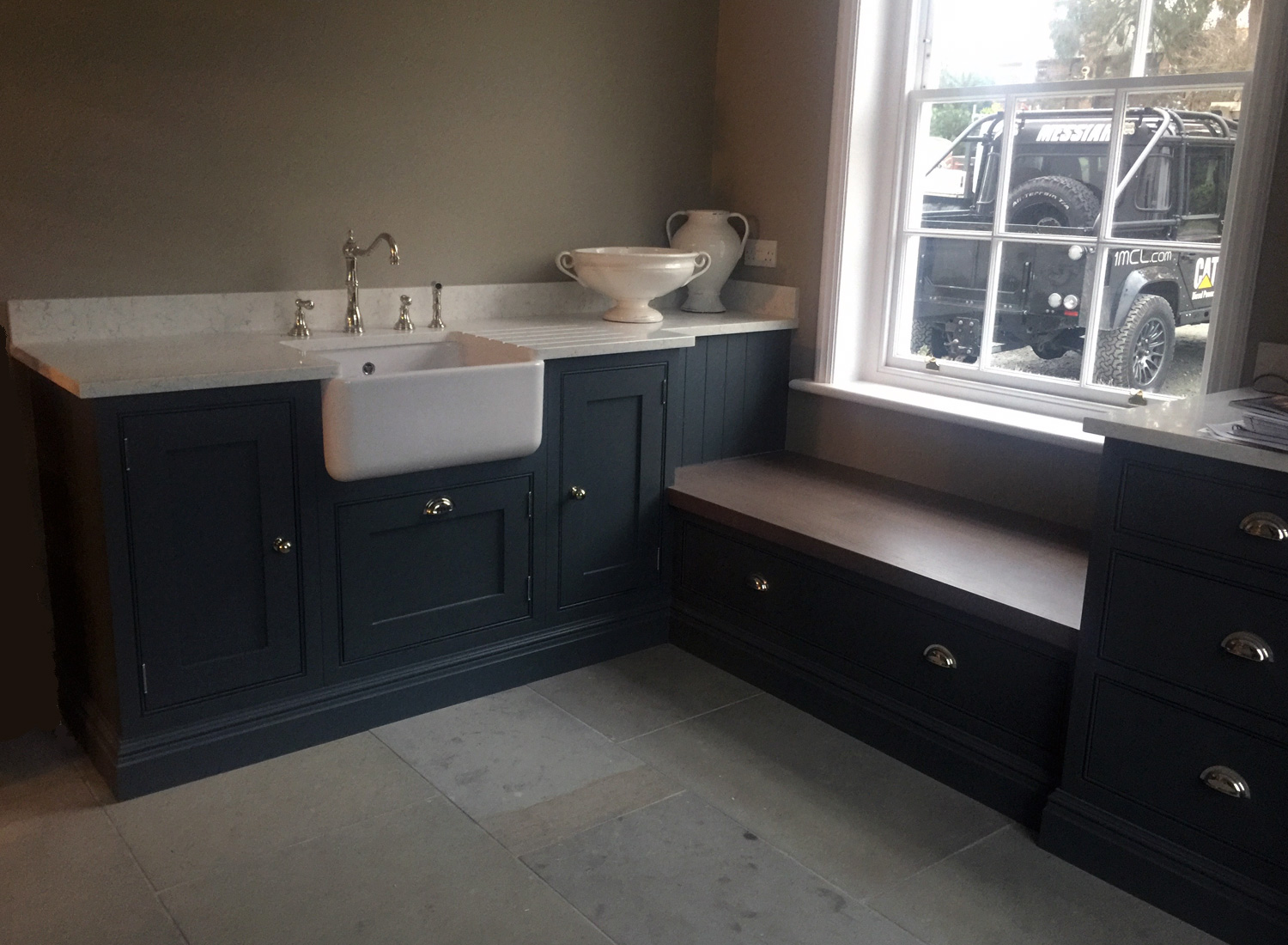
Bespoke utility from Reeve & Co — handmade in our Suffolk workshop for high-end homes across London, the Home Counties and East Anglia.
Utility rooms, boot rooms, pantries and dog showers
Utility Rooms & Boot Rooms
The best ancillary rooms are not afterthoughts. They remove noise, clutter and daily pressure from the kitchen, hall and living spaces, while still feeling like part of the same high-end joinery scheme.
A hard-working room, drawn with the same care as the kitchen
A utility room has to deal with washing machines, drying space, cleaning stores, recycling, linen, coats, muddy boots and sometimes dogs. A boot room has to deal with the way people actually enter the house. Both rooms need practical thinking before they need decoration.
We design these rooms as furniture-led joinery, not just as a row of cupboards. Bench heights, peg rail positions, appliance ventilation, sink access, wet zones, tall storage and baskets all need to be drawn around the household.
Laundry hidden properly
Machines can be stacked or concealed behind joinery, with ventilation and access considered before the cabinetry is made.
Boot-room storage
Coats, boots, bags and baskets need a proper place if the kitchen and hall are to stay calm.
Dog showers and wet zones
Raised trays, washable finishes and towel storage make a dog wash feel designed, not bolted on.
Designed with the kitchen
Where possible, we plan the utility, pantry and boot room at the same time as the kitchen. This gives the house a consistent language while allowing each room to work differently.
Useful in older and larger houses
Country houses, family homes and listed properties often need ancillary storage as much as they need a beautiful kitchen. These rooms are where daily life is absorbed.
What to consider before commissioning
The most useful brief starts with the jobs the room must do. Laundry, drying, coats, dog washing, recycling, cleaning stores, wine storage and pantry overflow each require different joinery decisions.
If the room includes plumbing, drainage, ventilation or underfloor heating, we coordinate the joinery with the builder, plumber or architect so the fitted furniture and services work together.
Frequently asked questions
Can a utility room be commissioned without a kitchen?
Yes. A standalone utility, boot room or pantry is a normal commission where bespoke joinery is the right answer.
Can it match an existing kitchen?
Often, yes. We can echo door style, paint colour, ironmongery and timber details, or deliberately make the utility simpler and more robust.
Do you make dog showers?
Yes, where the drainage and waterproofing are planned properly with the builder or plumber.
Where do you work?
We make the cabinetry in Suffolk and fit projects across Suffolk, Essex, Cambridgeshire, Norfolk, London and the Home Counties.
The working rooms of the house, done properly
A utility room or boot room is not a secondary commission. It is the room that gets used hardest — wet coats, muddy boots, laundry, dog leads, school bags — and the cabinetry has to perform accordingly. It also, increasingly, has to look right: the working rooms of a well-designed house are now part of the interior, not hidden behind a closed door.
We make utility rooms and boot rooms from the same materials and to the same construction standard as our kitchens. Solid timber face frames. Dovetailed drawers. Properly fitted mechanisms. Durable painted finishes that clean easily and last. The cabinetry is designed to match the kitchen — in style, colour and profile — so the whole ground floor reads consistently.
Boot rooms
A boot room brief is usually a combination of open coat hanging, bench seating with storage below, cubbyholes for boots and shoes, and at least one set of closed cupboards for things that need to be out of sight. We design each of these elements to work together as a fitted composition rather than a collection of furniture items.
The bench is typically solid timber — oak or painted hardwood — at a height that works both for seating and as a surface to put things down on. Storage below the bench can be open cubbies for boots, or pull-out drawers, or a combination. The coat rail is typically above the bench, with a high rail for coats and a lower hook rail for shorter items. The whole thing is drawn to fit the room exactly, including any skirtings, architraves or wall features that affect the design.
What we make for utility and boot rooms
Fitted laundry cabinetry
Base units with pull-out storage, integrated appliance housings for washing machine and dryer, a solid worktop for folding and sorting, and wall cupboards above. The same in-frame or shaker profiles as the kitchen, in matching paint.
Boot room seating and storage
Solid timber bench, coat hooks above, boot cubbies below. Open storage for everyday use, closed cupboards for less-used items. Designed to the length and height of the room with proper skirting and pelmet details.
Larder and pantry storage
A full-height larder cupboard adjacent to the kitchen — or in a walk-in larder room — fitted with pull-out shelving, wine storage, vegetable drawers and properly ventilated sections. Designed as part of the kitchen scheme.
Dog washing and outdoor kit storage
Boot rooms for country properties often include a low-level dog wash — a tiled surface with a hose fitting — and dedicated storage for outdoor kit, guns and field sports equipment. We design these as integrated parts of the room.
Sink and tap housing
A deep utility sink — ceramic, stainless or stone — in a painted base unit is standard in most utility room commissions. We design the surrounding cabinetry to give it the right housing, including open storage below for cleaning products.
Painted finishes to match the kitchen
The utility room is painted in the same colour and finish as the kitchen. We mix and apply all finishes in-house, which means a consistent result between rooms rather than a close-but-not-quite match between two different paint batches.
Designed alongside the kitchen
The most coherent result — and the most common way we work — is to design the utility room and boot room at the same time as the kitchen. The door profile, the paint colour, the worktop material, the hardware and the internal fittings are all specified as part of the same project. The rooms are made together and installed together.
It is also possible to commission a utility room or boot room alongside an existing kitchen. If there is existing joinery in the house that the new work needs to relate to, send us photographs and we will advise on what can be matched and what needs to be adapted.
Boot room and utility room commissions across East Anglia
Utility rooms and boot rooms are a significant part of our work in Suffolk, Norfolk, Essex and Cambridgeshire. Country houses, farmhouses, manor renovations and barn conversions across the region frequently include a utility room commission alongside the kitchen. We design and fit these rooms as part of the wider project, and we take on standalone utility and boot room commissions where the brief suits the workshop.
Utility and boot room questions
Can you make a boot room to match an existing Shaker kitchen?
Yes. If we made the original kitchen, we have the drawings and can manufacture matching cabinetry. If the kitchen was made by another supplier, send photographs and we will advise on what can be matched in our own production.
What is the difference between a utility room and a boot room?
A utility room typically contains the laundry appliances — washing machine, dryer — plus storage, a sink and a worktop. A boot room is an entrance lobby with coat storage, boot cubbies and seating. In practice, many commissions combine both functions in a single room, particularly in farmhouses and country properties where the two rooms adjoin. We design both.
Do you make gun rooms and field sports storage?
Yes. We make gun rooms, gun cupboards and field sports storage as part of our fitted joinery work. These are frequently commissioned alongside a kitchen and utility room as part of a wider project. Talk to us about your requirements.
How much space does a boot room need?
A functional boot room can be achieved in a corridor or lobby from about 1.5 metres in depth and 2 metres in width. A proper boot room with seating, closed storage and a coat rail benefits from more space — 2.5 metres or more in depth. We design to the available space; send us the dimensions and we will show you what is achievable.
Planning the working rooms around real routines
A utility room or boot room fails when it is designed as spare space. It succeeds when it is planned around the real routine of the house: where people enter, where dogs are washed, where coats land, how laundry moves, where cleaning products live and what has to be hidden from the main kitchen.
For larger homes, the utility can become a back kitchen, pantry, flower room or laundry room. For smaller homes, it might be one hardworking wall of cabinetry that absorbs the things a kitchen should not have to show. In both cases, bespoke joinery lets the storage follow the behaviour rather than the other way around.
We treat these rooms with the same care as the kitchen because they often make the difference between a beautiful room and a house that works.
Laundry needs airflow
Stacked machines, drying cupboards and utility sinks need ventilation, service access and practical surfaces.
Boot rooms need honest dimensions
Coats, boots, bags and dog towels are bulky. The joinery should be sized for real objects, not neat drawings.
Dog areas need durable detail
A dog shower or wash area needs waterproofing, drainage, towel storage and finishes that can be cleaned easily.
Materials can be tougher
The utility or boot room can share the kitchen language while using more robust paint, stone, tile or oak details.
Local kitchen work, national joinery standards
For bespoke kitchens our main local focus is Suffolk, Essex, Norfolk and Cambridgeshire, but Reeve & Co also fits high-end kitchens and fitted furniture nationally. We are regularly working in London on residential joinery projects, so the workshop is used to delivering the same level of detail for townhouses, country homes, apartments and larger private houses well beyond East Anglia.
Have a hard-working room to plan?
Tell us what the room needs to absorb day to day and we will draw the cabinetry around that use.
From our Suffolk workshop we design, make and install bespoke utility and boot rooms for high-end homes across London, the Home Counties and East Anglia. Every commission is made to measure and finished to a furniture-quality standard. To discuss bespoke utility, get in touch or explore our case studies.
We use cookies to keep the site working, and — only if you allow it — to understand how it is used. Nothing is set for measurement until you choose. You can change your mind at any time.
Functional
Always active
The technical storage or access is strictly necessary for the legitimate purpose of enabling the use of a specific service explicitly requested by the subscriber or user, or for the sole purpose of carrying out the transmission of a communication over an electronic communications network.
Preferences
The technical storage or access is necessary for the legitimate purpose of storing preferences that are not requested by the subscriber or user.
Statistics
The technical storage or access that is used exclusively for statistical purposes.The technical storage or access that is used exclusively for anonymous statistical purposes. Without a subpoena, voluntary compliance on the part of your Internet Service Provider, or additional records from a third party, information stored or retrieved for this purpose alone cannot usually be used to identify you.
Marketing
The technical storage or access is required to create user profiles to send advertising, or to track the user on a website or across several websites for similar marketing purposes.