Bespoke Staircases
A staircase is the first thing you see when you walk into a house, and the one piece of joinery everyone touches every day. We design, draw, build and fit bespoke staircases for prime and super prime residential houses, listed buildings and the architects who specify them — in solid oak, walnut and hand-painted hardwood, from a single straight flight to a sweeping cantilevered centrepiece.
View the gallery ↓A staircase should be the finest piece of joinery in the house
Most staircases are bought as a kit and assembled on site. A Reeve & Co staircase is designed for one house, drawn full-size, and cut and jointed by hand in our Suffolk joinery workshop. Every tread, string and handrail is made to a measured survey of your stairwell, so the flight sits true, the rise stays consistent from bottom step to top, and the handrail flows in one continuous, unbroken line around half-landings and turns.
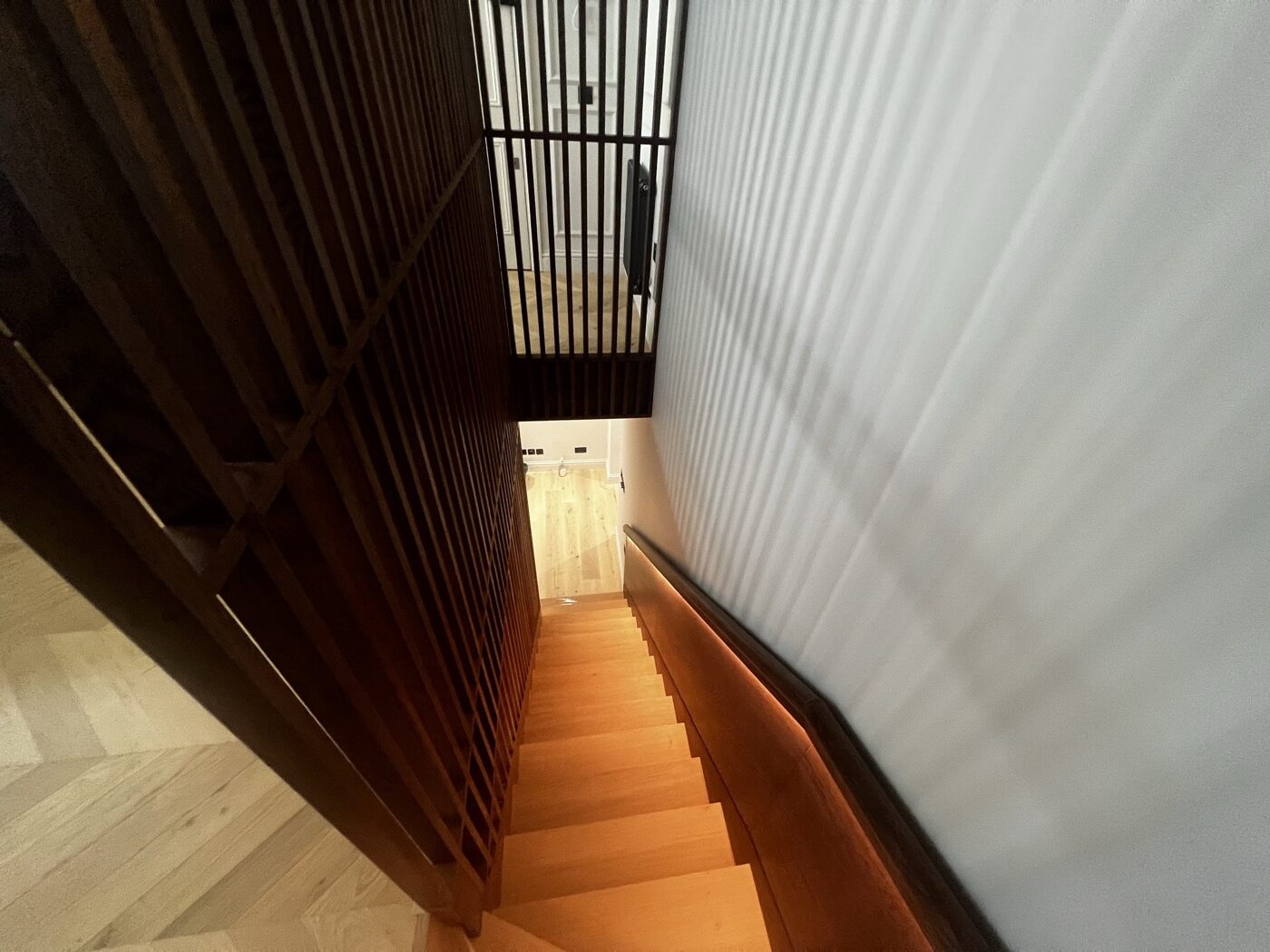
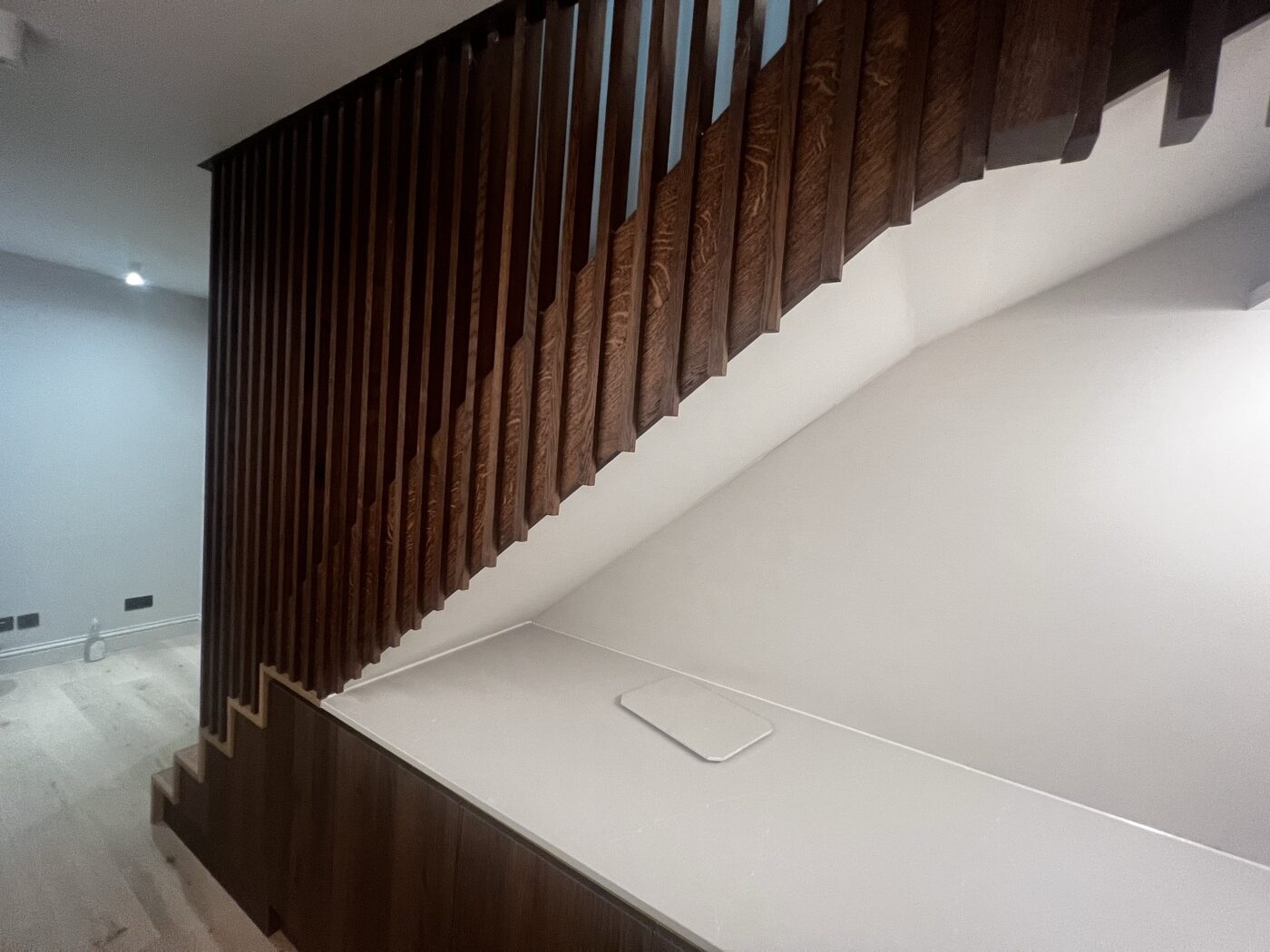
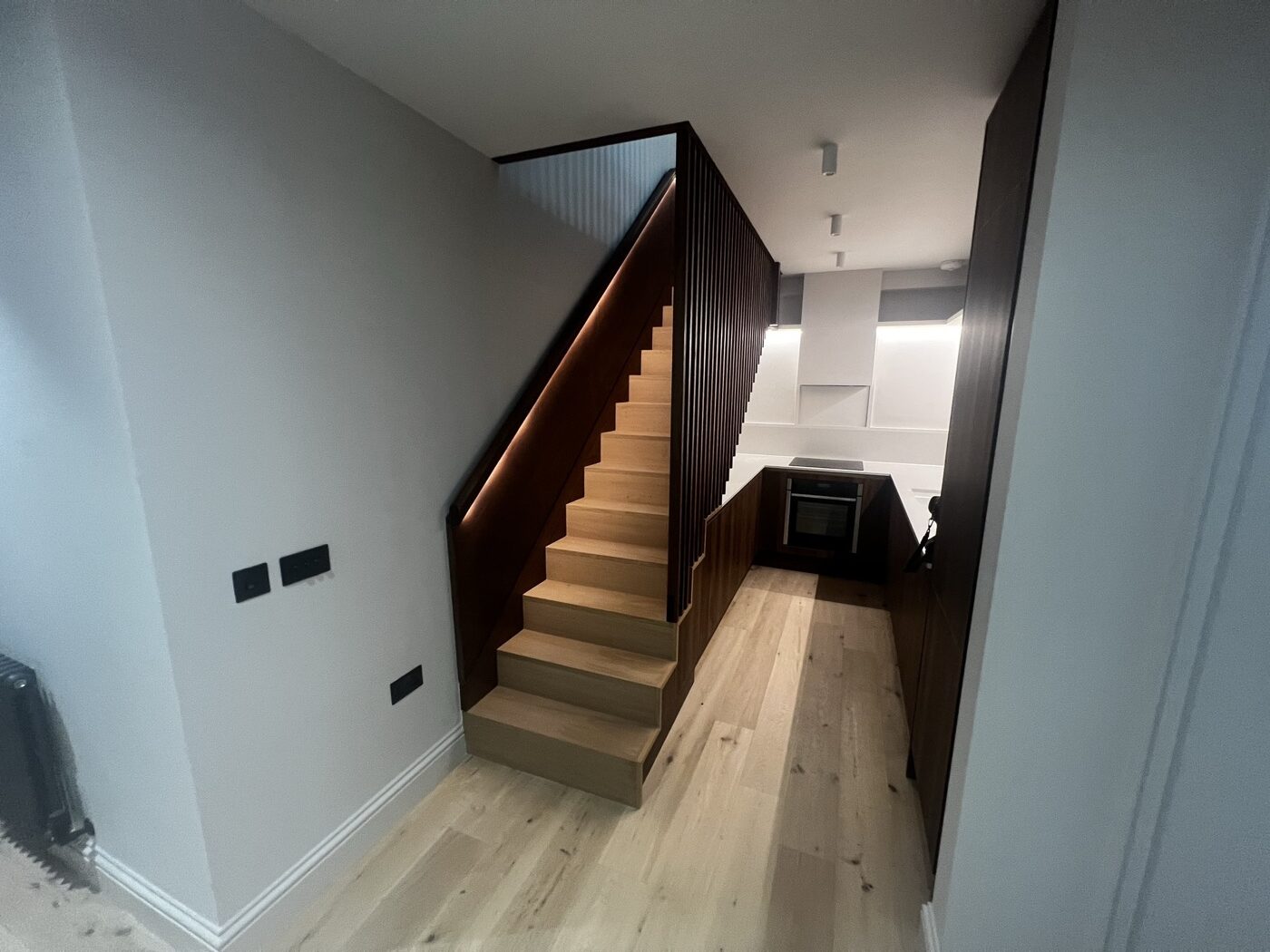
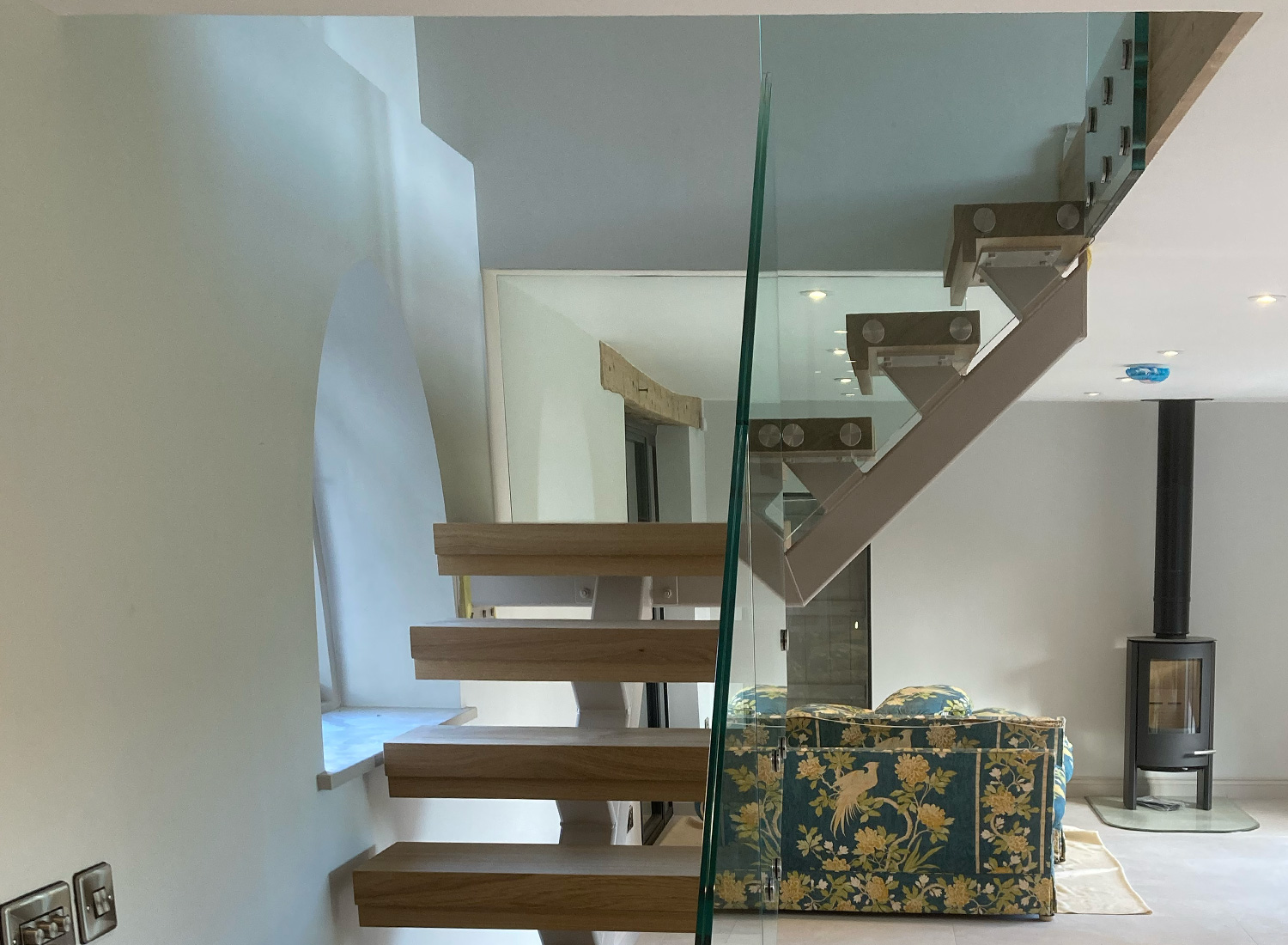
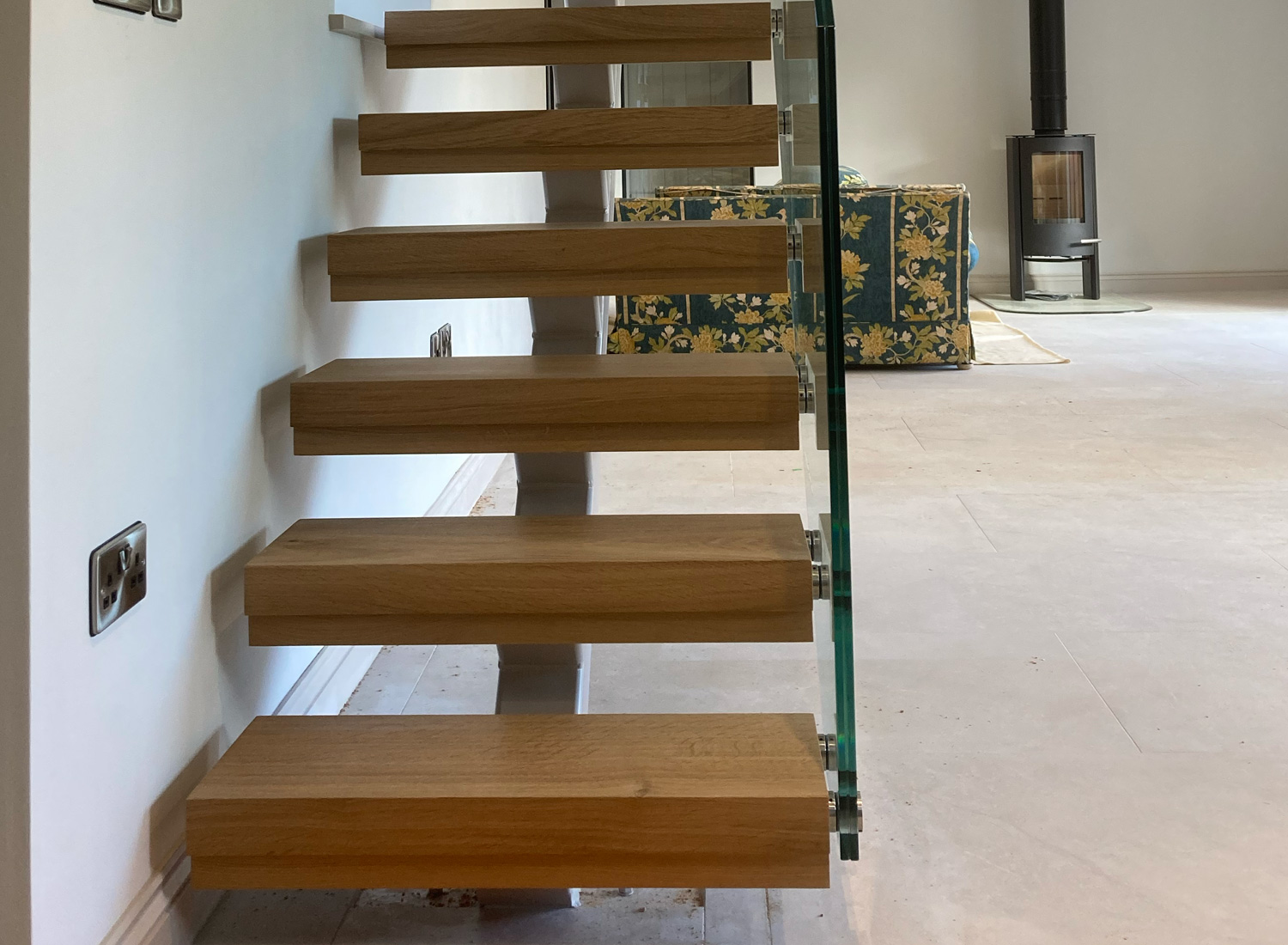
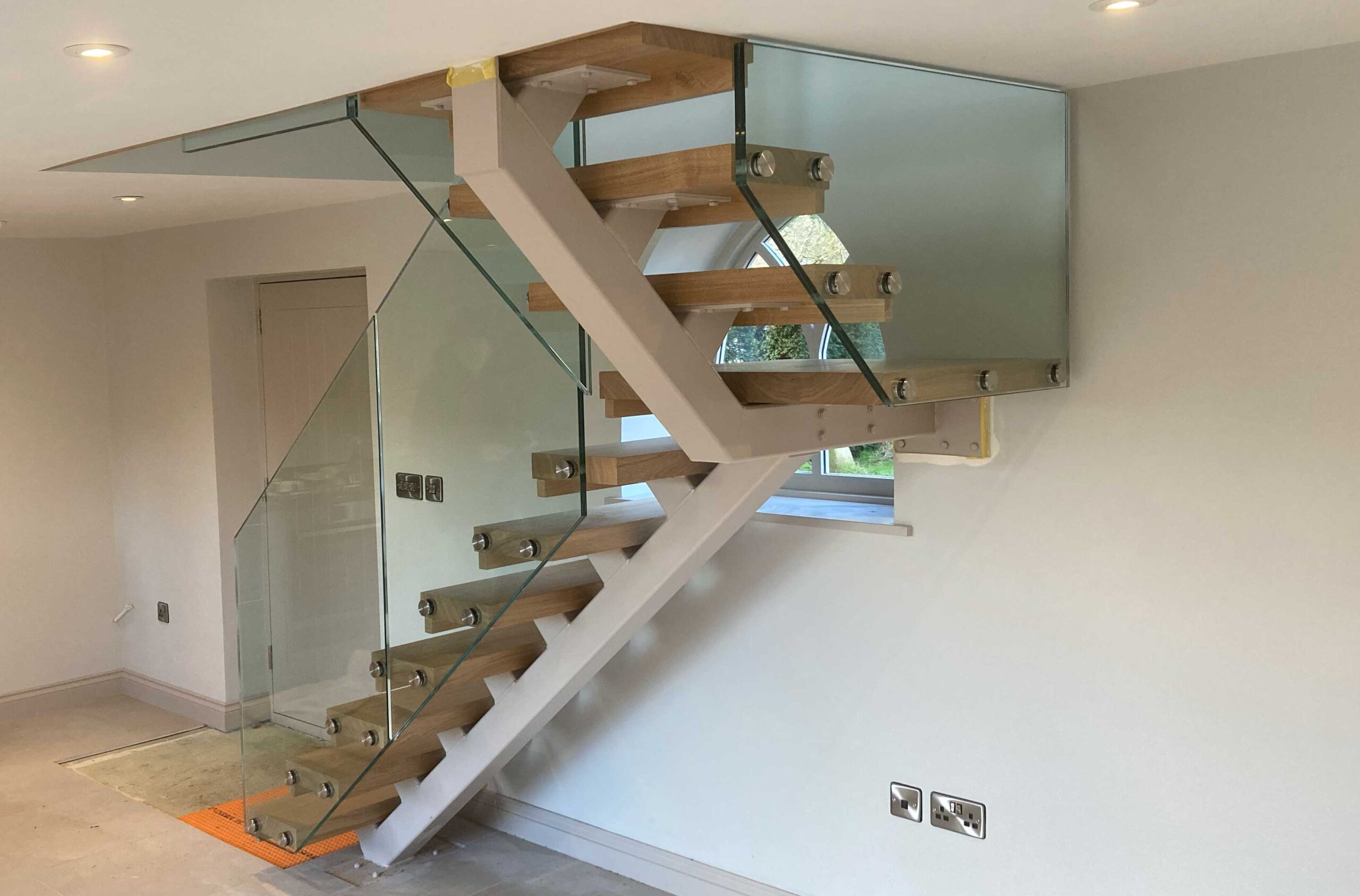
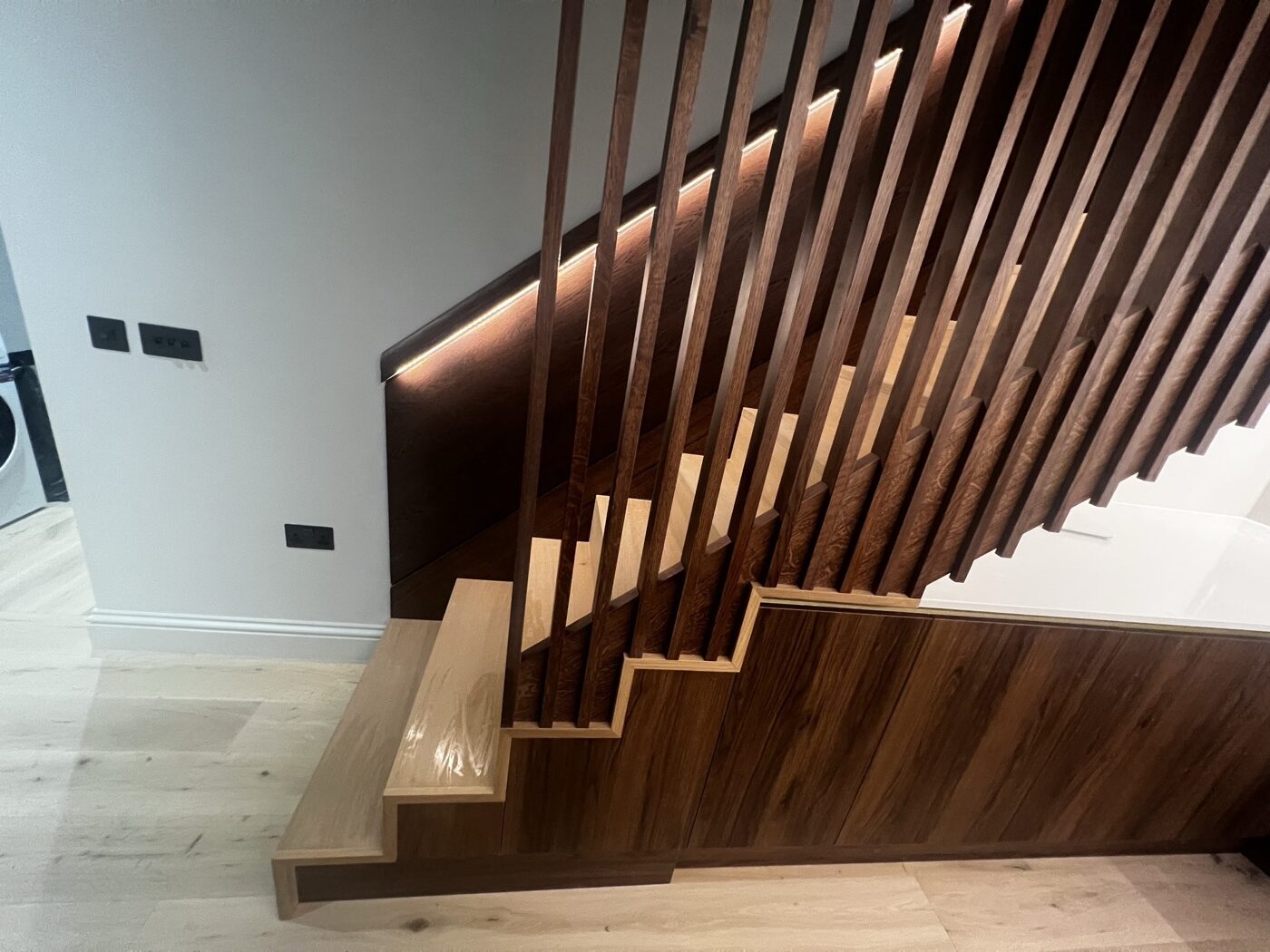
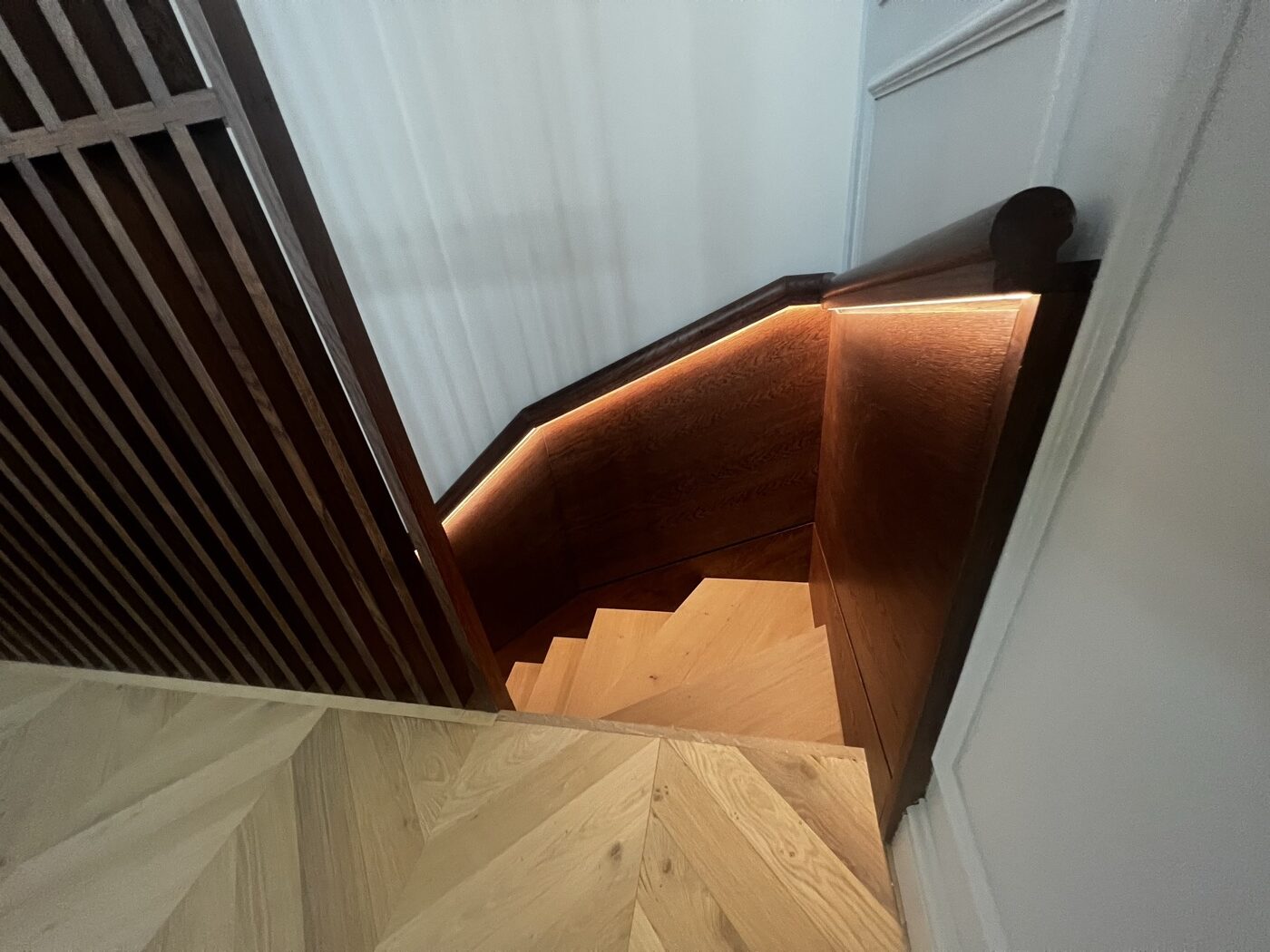
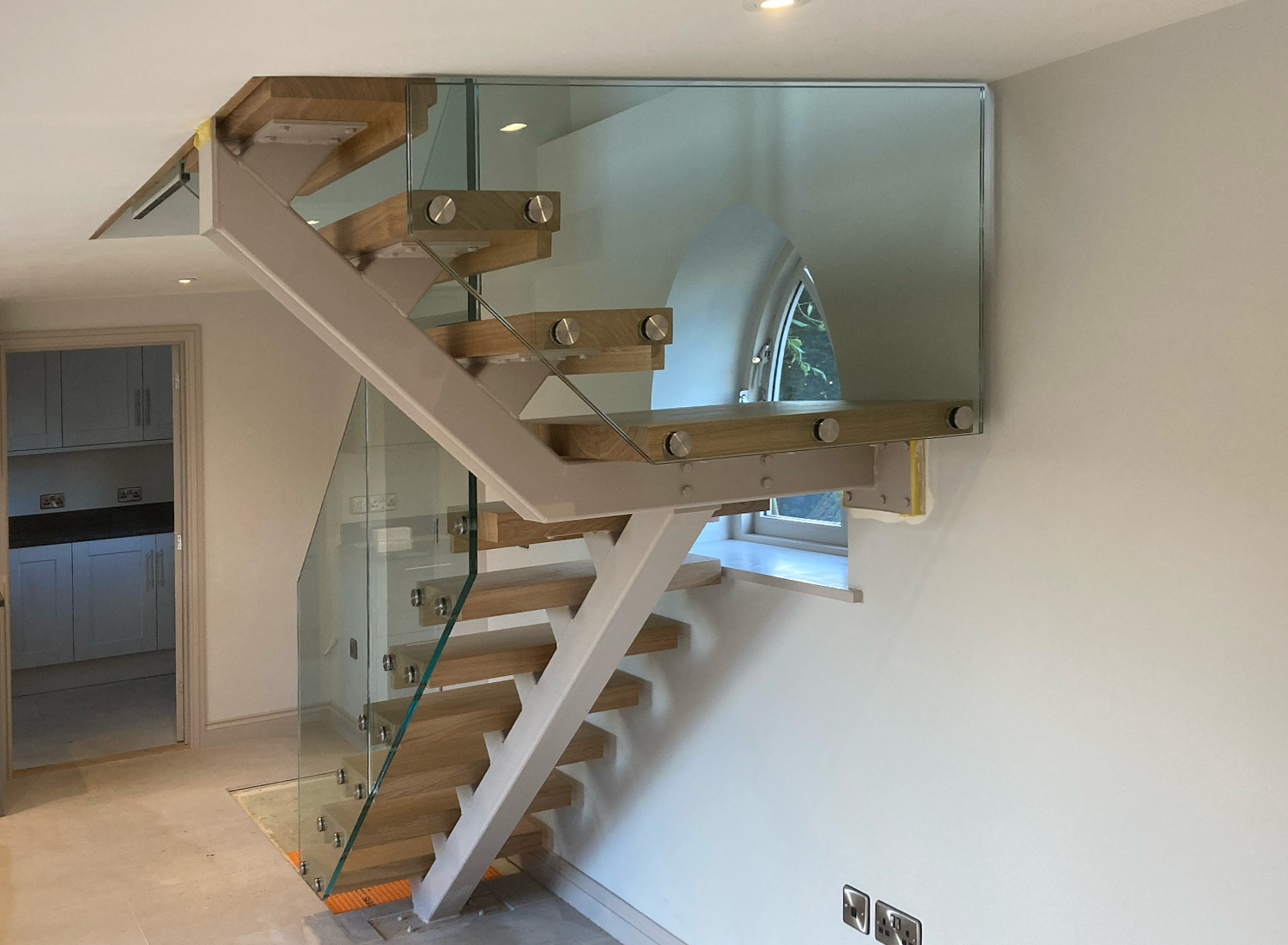
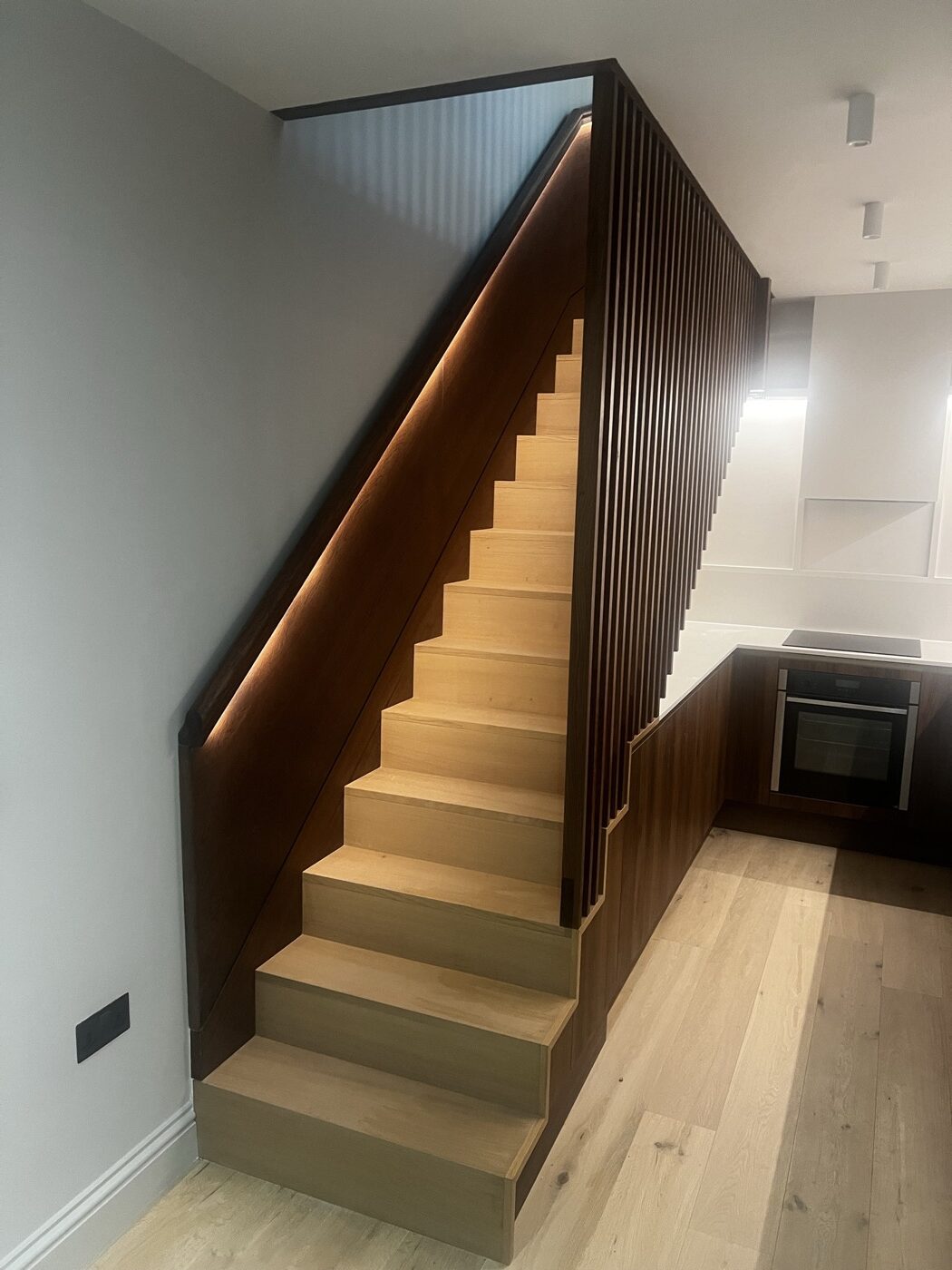
We have built staircases for Georgian and Victorian houses, new-build country homes, London townhouses and listed buildings under conservation control — including the slatted-oak staircase at our Beaufort Gardens project in Knightsbridge. Whether you want a faithful period staircase with turned balusters and a scrolled volute, or a contemporary open flight with floating oak treads and a frameless glass balustrade, the same craftsmen make it and our site team fits it. Nothing is sub-contracted to a staircase factory.
What a bespoke staircase commission can include
Most commissions combine several of the elements below — from a single replacement flight to the whole vertical journey through a house.
Straight & dog-leg flights
A straight run, a dog-leg with a half-landing, or an L-shaped flight with winders — built with housed strings and glued, wedged and blocked treads so the staircase stays silent underfoot for decades.
Cut-string staircases
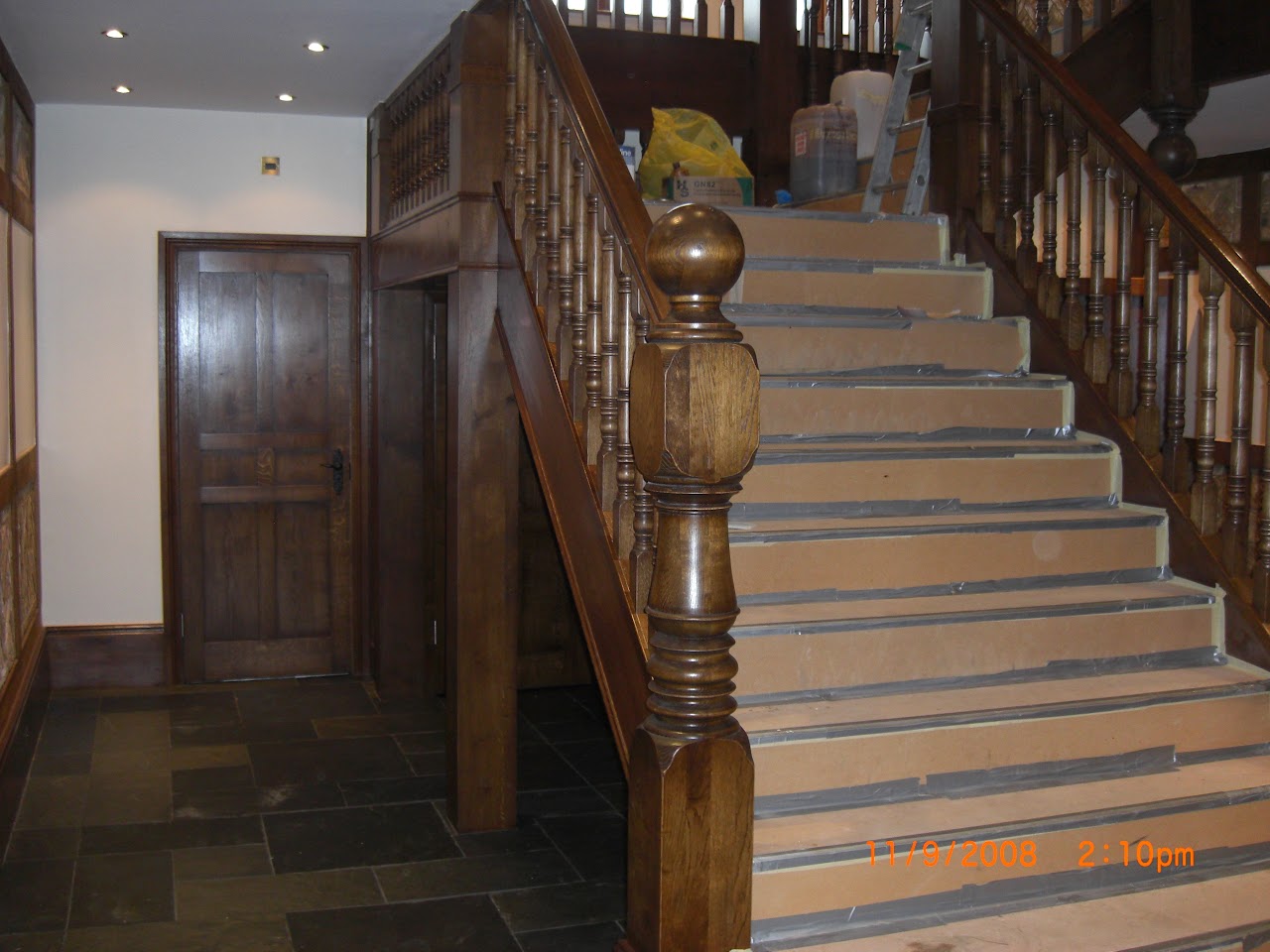
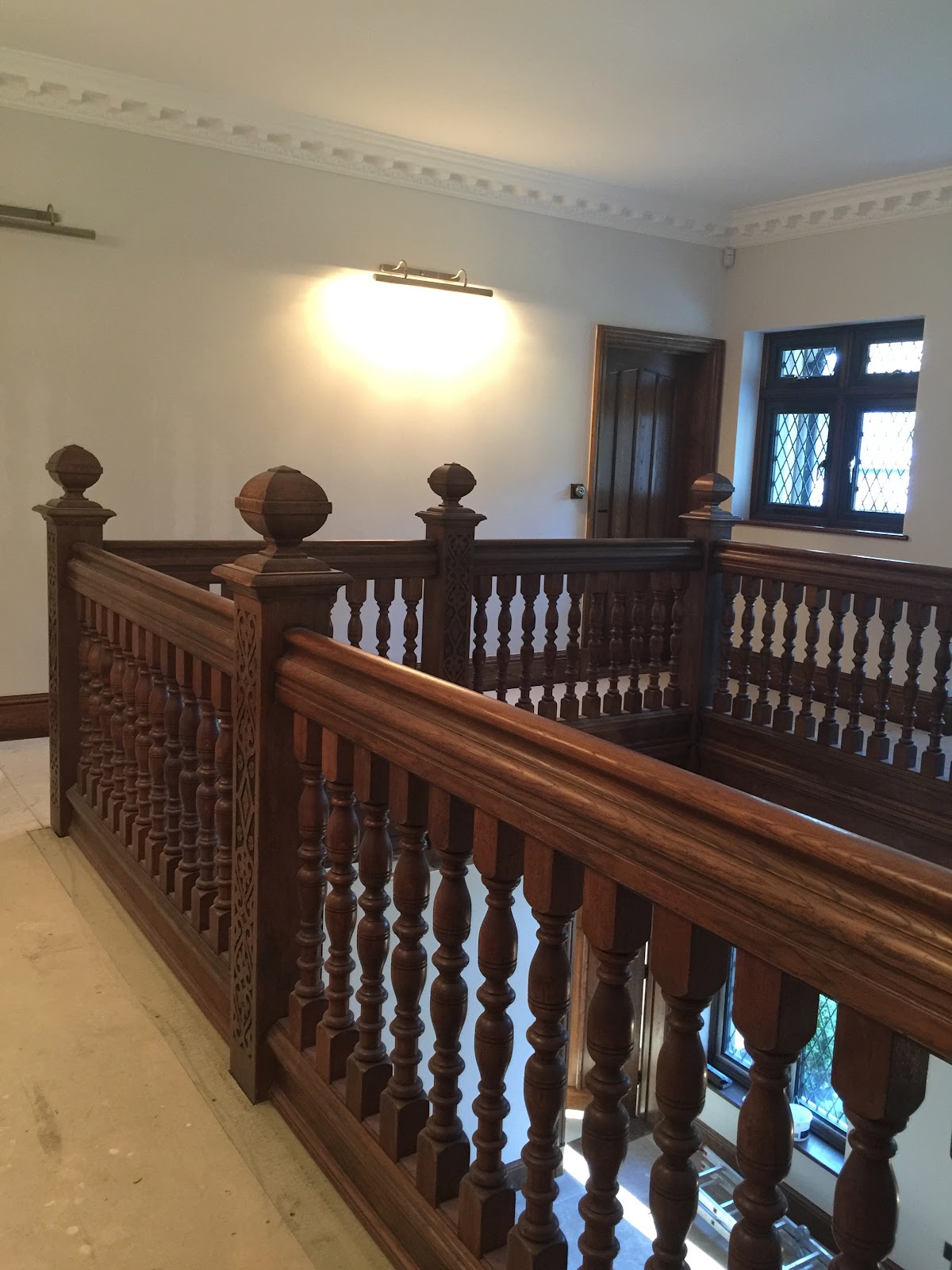
The outer string cut and mitred to follow the line of the treads, exposing each step from the side. Shaped step-ends, turned or square newels and a moulded handrail — the traditional choice for a hall meant to be seen.
Curved & helical flights
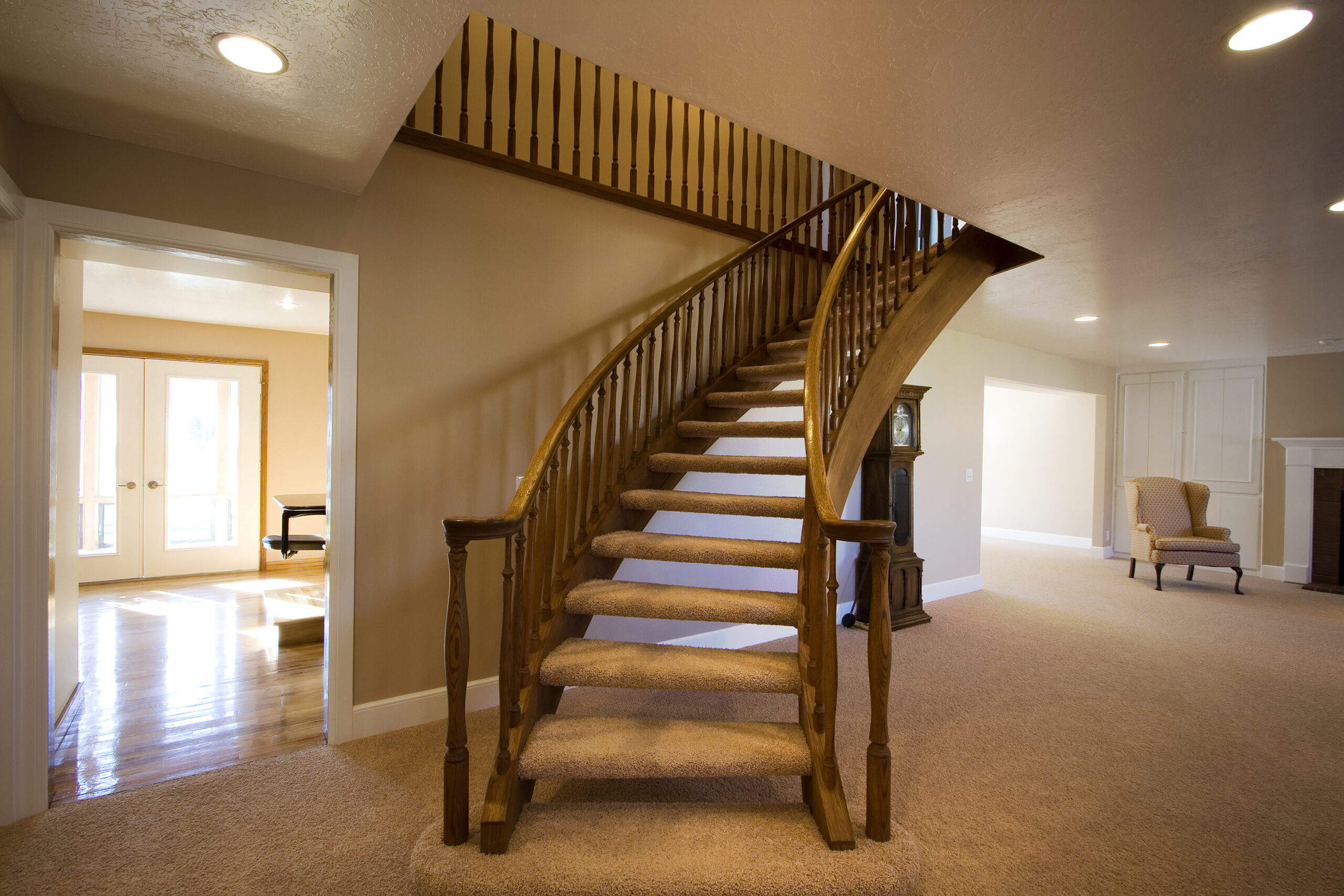
Sweeping curves and continuous helical flights, with strings and handrails laminated in solid timber around a former. Drawn full-size, set out on the workshop floor and engineered to span without intermediate support.
Cantilevered staircases
Treads that appear to float from the wall, with the structure concealed inside the wall or the treads themselves — a precise, heavily engineered centrepiece for a double-height hall.
Balustrades & handrails
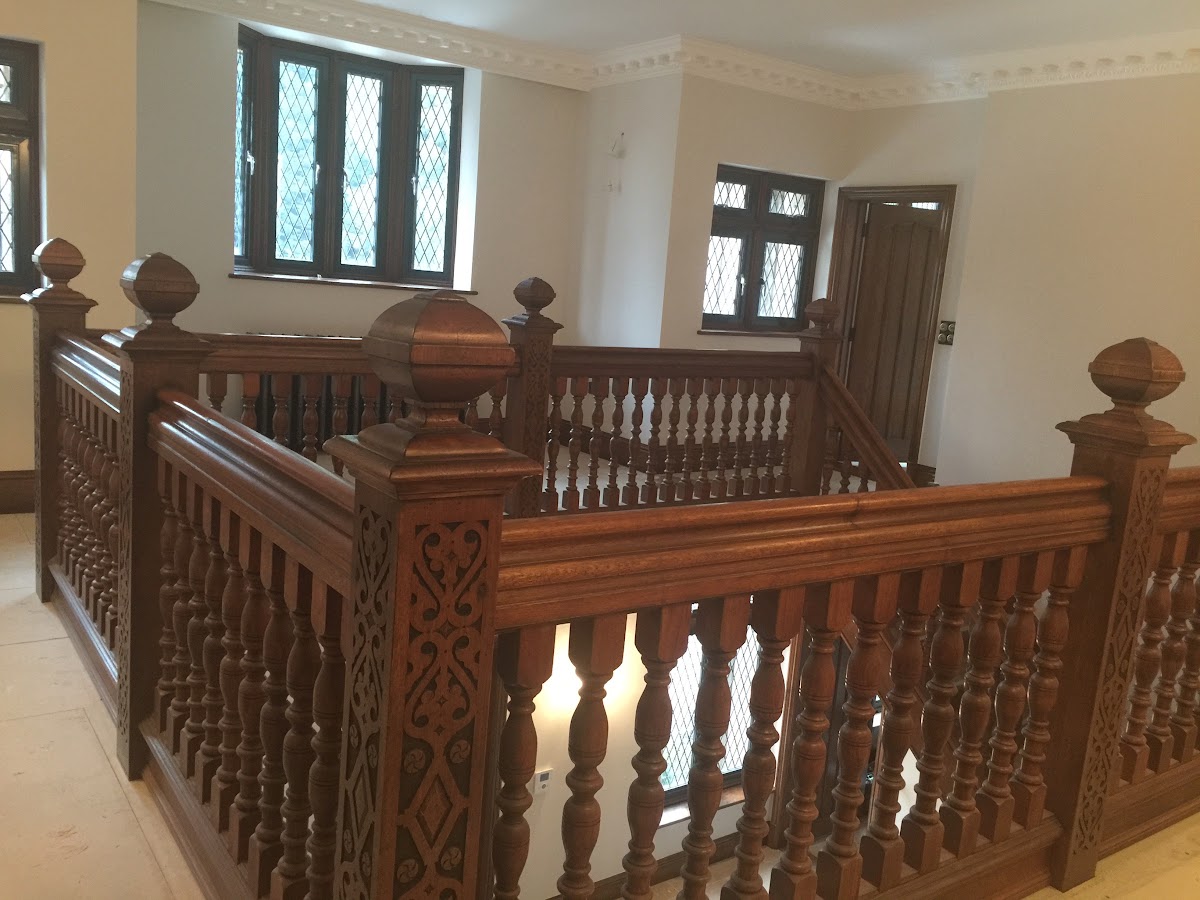
Turned, square or barley-twist spindles, fretwork panels, frameless glass or forged wrought iron, paired with a hardwood handrail shaped to sit in the hand. Made together with the flight so the line is truly continuous.
Newels, spindles & detailing
Hand-turned newel posts, carved caps, volutes and scroll-ends, and the small mouldings that separate a bespoke staircase from a merchant’s kit. Patterns matched to an existing staircase where needed.
Period, contemporary, or a considered blend
Our work divides roughly into two traditions, with a good deal of ground in between. Period staircases — turned balusters, swept and ramped handrails, scrolled volutes and panelled spandrels — are drawn from photographs, surveys and the details already present in the house, and built so that a new flight reads as though it has always been there. Contemporary staircases are about restraint: open risers, floating treads, frameless glass and slim steel, where the quality is in the clean line of a single length of handrail. Many of the staircases we are asked for sit deliberately between the two — a traditional carcase with a glass balustrade, or a modern open flight in richly figured oak. Because we draw and make every component ourselves, alongside our wider bespoke joinery and timber panelling work, we are never tied to a catalogue of standard parts.
Structural design and building regulations
A staircase is joinery and structure at the same time, and it has to satisfy Part K of the Building Regulations. We set out every flight to a consistent rise and going, maintain the required headroom, keep balustrade heights correct, and ensure no gap allows a 100 mm sphere to pass — the standard that protects young children. For longer spans, cantilevers and open flights we work with the structural engineer and main contractor to agree fixings and load paths before anything is cut. In listed buildings we prepare drawings that support a listed-building consent application and detail the staircase sympathetically to the period of the house.
Materials and finishes for bespoke staircases
The staircase is usually finished to tie in with the doors, joinery and floor around it. Common specifications include:
French-polished oak
Traditional hand-applied shellac, built up and burnished to a deep, warm sheen — the classic finish for a period oak staircase.
Painted hardwood
Strings, spindles and risers in hand-painted tulipwood or poplar, often with oak treads and handrail left natural for contrast.
Walnut & dark timbers
American black walnut and other dark hardwoods for a richer, contemporary look, oiled or lacquered to protect the surface.
Frameless glass
Toughened, polished-edge glass panels fixed with discreet stainless or brass clamps, or channel-set for a minimal line.
Wrought iron & metalwork
Forged iron balustrades and scrollwork, made with trusted metalworkers and finished to sit alongside the timber.
Integrated lighting
Concealed LED lighting to treads, strings or handrails, wired in during the build so no cable or driver is ever on show.
Recent staircase projects
The workshop and the team
Every staircase is made in our workshop at Mickfield in Suffolk, where traditional bench joinery sits alongside CNC machining. The machine cuts strings and housings to a tolerance no hand could repeat; the hand work — the shaping of a volute, the easing of a handrail, the final polish — is where a staircase becomes a piece of furniture rather than a building component. The same cabinet-makers who build our hand-made kitchens and fitted furniture make the staircases, which is why the joinery in a Reeve & Co hall always feels of a single piece. We keep the whole process — survey, drawing, machining, bench work and finishing — under one roof and one team, with fitting by our site team.
Design considerations for a bespoke staircase
The best staircases are designed with the whole hall in mind, not drawn in isolation. We think about the proportion of the flight against the height of the void, the way daylight falls across the treads, and the single most important line in any staircase — the handrail — so that it sweeps without a break from newel to landing. We match mouldings, timber and finish to the doors and joinery already in the house, and we treat the understair as usable space: a cupboard, a panelled return, a seat or a discreet cloakroom.
Staircases for listed and period properties
Replacing or altering a staircase in a listed building is sensitive work that usually requires listed-building consent and often the involvement of a conservation officer. We are well used to it: surveying what survives, identifying the period and the original detailing, and producing drawings that show exactly how a repair or a new flight will be carried out. New timber is matched to old in species, moulding and finish, and joints are cut in the traditional way so the work is sympathetic — and reversible where it needs to be. The result protects the character of the building while giving you a staircase that is safe, sound and good for another century. It is the same conservation-led approach we bring to our timber panelling and period fitted joinery.
Caring for a hardwood staircase
A well-made timber staircase asks very little of you. We hand over finishing notes for the oil, lacquer or French polish we have used, so the surface can be refreshed rather than stripped. Treads in a busy family hall can be protected with a runner on traditional brass stair rods, and handrails benefit from an occasional wax. Solid timber moves a little with the seasons, which is why our treads are glued, wedged and blocked rather than simply screwed — the construction stays tight and silent for decades.
How the commission works
We survey and measure the stairwell, take in any architect’s drawings, and discuss how you want the staircase to look and feel. We then produce full-size setting-out and a fixed-price quotation before any timber is cut. The flight, balustrade and handrail are built and dry-assembled in the workshop, finished, then delivered and fitted by our site team, with a final polish once the building work around it is complete. One workshop is responsible from first drawing to final handrail.
Who commissions bespoke staircases from Reeve & Co
We work for private clients building or renovating a family home; for architects and interior designers who need a maker who can deliver a complex flight exactly to drawing; for main contractors on high-end residential projects; and for owners of listed and period properties. Most of our work is across East Anglia (Suffolk, Essex, Cambridgeshire and Norfolk), London and the Home Counties. You can see completed projects in our case studies, or explore our bespoke doors, windows and hand-made kitchens.
Bespoke staircase FAQs
How long does a bespoke staircase take?
Allow around three months from order. A typical flight needs four to six weeks in the workshop once drawings are signed off, plus survey and fitting time. Curved, helical and cantilevered staircases take longer; we confirm the programme with your build schedule.
Do you fit as well as make?
Yes. Every staircase is delivered and installed by our site team. We protect the work on site and return to apply the final finish once the surrounding building work is complete.
Can you match an existing staircase or balustrade?
Yes. We regularly extend or repair period staircases and turn replacement balusters and newels to match an existing pattern, so new work is indistinguishable from the original.
Will the staircase meet building regulations?
Always. Every flight is set out to Part K — consistent rise and going, correct headroom, guarding heights and the 100 mm sphere rule. For listed buildings we provide drawings to support a listed-building consent application.
What does a bespoke staircase cost?
It depends on the design, timber and balustrade. A straightforward replacement flight is a modest project; a curved or cantilevered centrepiece with a glass or forged-iron balustrade is a significant one. We give a fixed price after survey and drawings.
Which areas do you cover?
Most of our staircase work is across East Anglia (Suffolk, Essex, Cambridgeshire and Norfolk), London and the Home Counties, with selected projects further afield. The staircase is made in our Mickfield workshop and fitted by our site team.
Detail & craftsmanship
Discuss your staircase
Send us your plans, or a few photos of the stairwell, and we’ll survey the space, draw the staircase full-size, quote a fixed price, then build and fit it for you.