Bespoke Gun Cabinets
Gun cabinets hand-made in solid oak, walnut and mahogany over a steel-lined carcass — drawn around your collection, built in our Suffolk workshop, and delivered and installed anywhere in the UK. From £7,000 plus VAT.

A steel box wearing a very good suit
The steel does the work. The timber is why you are willing to have it in the drawing room rather than hidden in a garage.
Almost every gun cabinet sold in this country is a steel box, and there is nothing wrong with that — a steel box, properly fixed, does the job it was designed to do. The trouble is what it does to a room. In a farmhouse utility it is invisible and irrelevant. In a panelled study, a library or a boot room that has been thought about, it is the one object that ruins the photograph.
We have spent more than twenty years making the argument that you do not have to choose. A cabinet can be built to a specification that comfortably exceeds anything a domestic installation is likely to need, and still read as a piece of cabinetmaking — quarter-sawn, book-matched, moulded, French polished, and made to the proportions of the room it stands in.
Every cabinet is drawn for the room and for the collection. Nothing comes off a shelf. We start from your gun list and the wall it has to sit against, and the carcass follows from there.
How it is built

The carcass and the steel
The steel liner is the security. It is folded rather than simply cut and welded, which stiffens the panel and removes the weak seam that a folded edge would otherwise leave. Doors carry anti-cut pins on the hinge side, so that removing the hinges does not remove the door — the commonest attack on a cheap cabinet and the one most often overlooked.
Locking is by five-lever mortice locks to BS 3621, the same standard specified for final exit doors on a domestic property. On larger cabinets we use driven boltwork so that a single turn throws bolts along the full height of the opening rather than at one point.
Fixings are the part nobody photographs and the part that matters most. A cabinet is only as secure as what it is bolted to. We anchor into masonry wherever the structure allows, at specified centres, and we will tell you plainly if a wall will not take it.

Glass, where you want to see the collection
A glazed door changes what a gun cabinet is for. Closed and locked it is still storage; but a collection worth owning is usually worth looking at, and a great many of our clients want the guns visible rather than shut behind a timber panel.
Where doors are glazed we use laminated anti-bandit glass — 21.5mm as standard, and thicker where the height of the glass calls for it, because a taller pane needs more to resist the same blow. Laminated glass does not fall out when it breaks; it holds in the interlayer, which is the whole point. It is heavy, and the door and its hinging have to be designed around that weight from the start rather than adapted to it afterwards.
Where discretion matters more than display, exactly the same cabinet is made with solid timber doors, and nobody who walks past it will know what is inside.
Recent cabinets

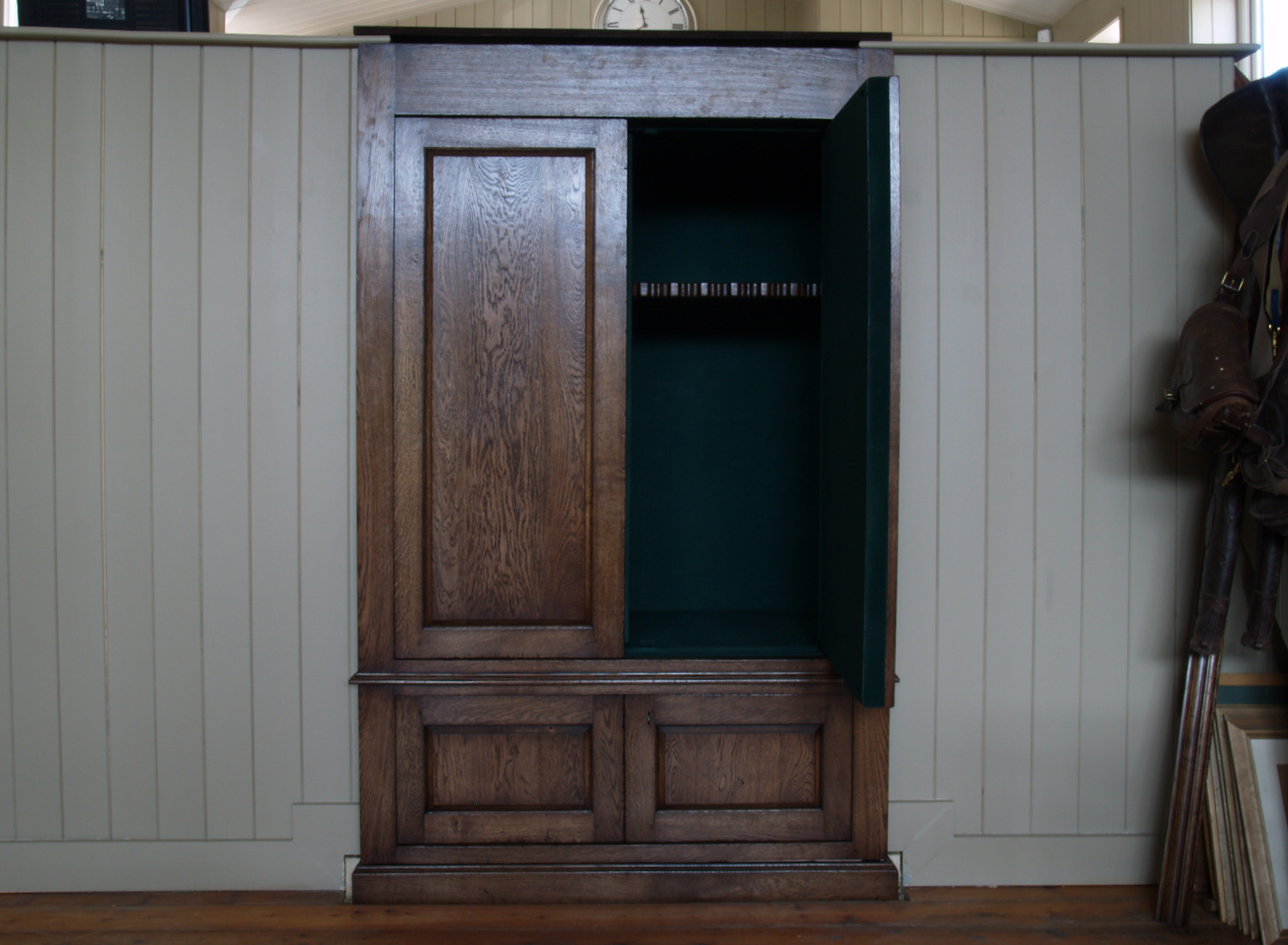
Doors open, everything to hand
Guns standing without touching, and a separate lockable ammunition compartment in the base.

A fitted run for a collection
Four glazed doors over a panelled base — a fitted run rather than a single cabinet.

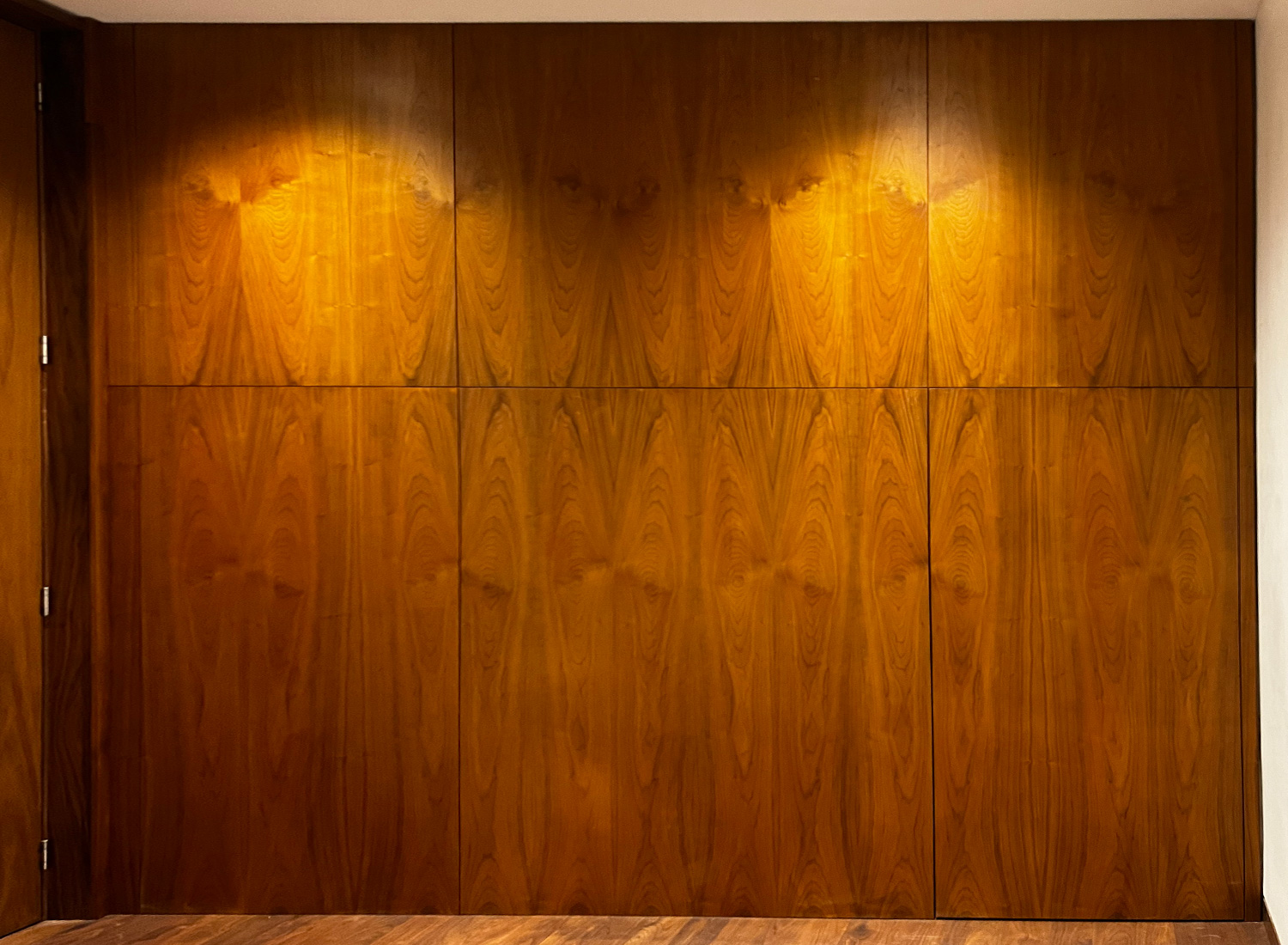
Solid, where discretion matters
An arched fielded panel and carved plinth. Nothing about it announces what it holds.

Cartridges, scopes and kit
A Wellington chest for cartridges, scopes, cases and cleaning kit, made to match the cabinet.

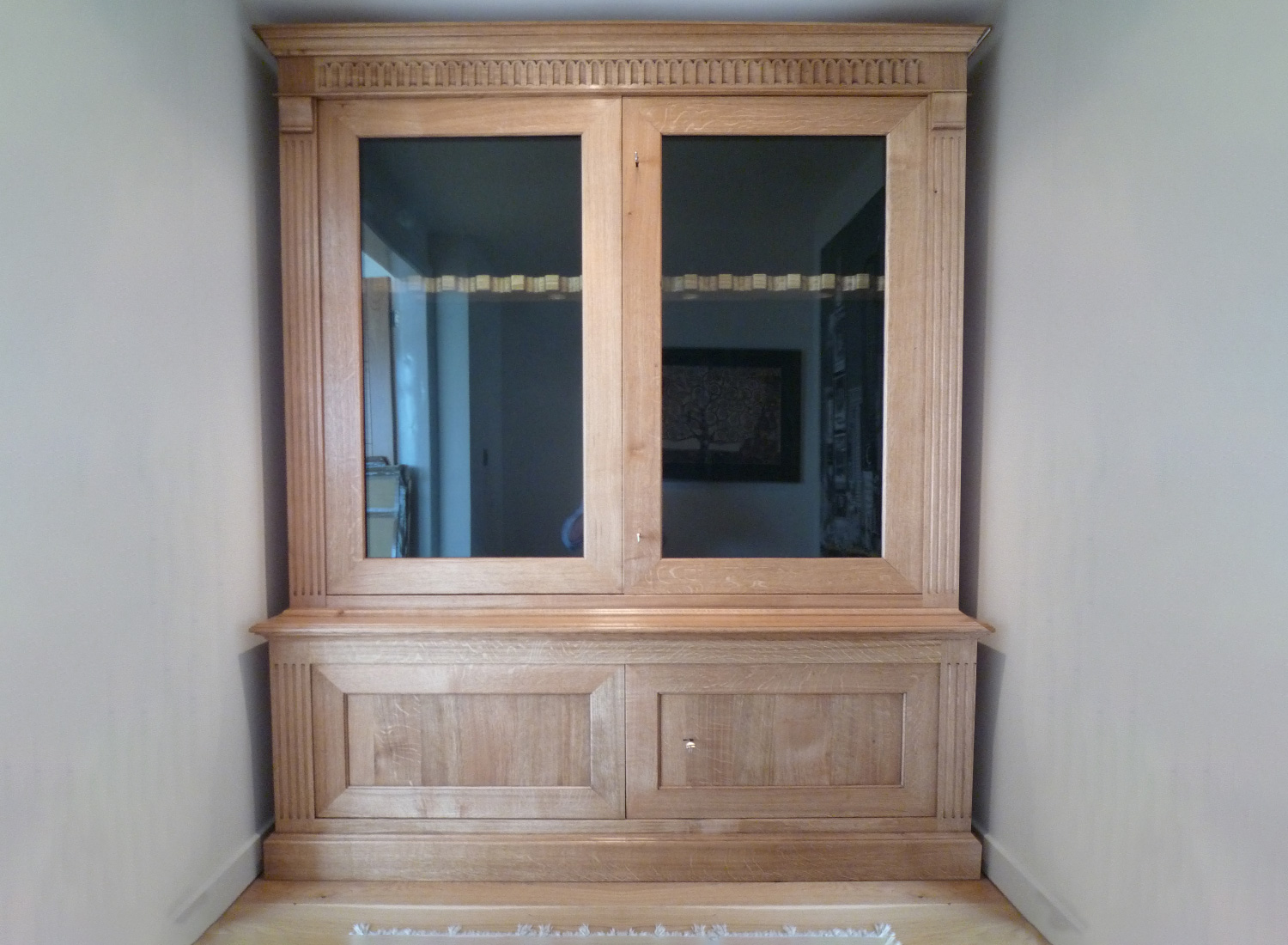
Antiqued to suit the room
Dentil frieze, twin glazed doors, and a finish antiqued so it sits with the furniture already there.

Built into the panelling
Set into a painted panelled wall so the run reads as joinery rather than as storage.
Made for the collection you actually own
A cabinet built to a standard size is a compromise for everybody. Side-by-sides, over-and-unders and rifles are all different lengths, and a rifle with a scope left mounted is a different object again from a rifle without one. If the interior is not drawn around what you have, you end up either wasting a third of the space or taking the scope off every time.
So we start with the gun list. Barrel racks are set out so that guns stand without touching each other, which matters more for the finish on a pair of London guns than most people expect. Heights are set so that scoped rifles go in scoped. Where a certificate requires ammunition to be held separately, that is a separate lockable compartment with its own lock, not a shelf inside the same door.
Beyond that it is a question of what else lives in the room. Felt-lined cleaning racks, drawers for cartridges and chokes, a slide for a cleaning rod, brass fittings, and lighting on a door switch so that you can actually see what you are reaching for in a dark corner of a boot room. None of it is standard, and all of it is drawn before anything is cut.
Timber and finish
The timber does the talking
Oak, walnut and mahogany are the three we are asked for most, and each behaves differently. Oak is the workhorse: quarter-sawn it shows medullary ray and it is hard enough to take a knock in a boot room. Walnut is the show timber — book-matched across a pair of doors it is the reason people stop and look. Mahogany suits a formal room and a French polished finish better than either.
Where a room is already painted, we make in hardwood and hand-paint it, which lets the cabinet disappear into an existing scheme rather than competing with it.
Finishes run from French polish, through hand-oiled, to hand-painted, and we antique where the room asks for it — a new cabinet in a house full of old furniture can look wrong precisely because it is too perfect. All finishing is done in our own spray booth and prep room by our own polisher, not sent out.

We talk to your firearms enquiry officer first
This is the part of the process most makers leave to the client, and it is the part that causes every unpleasant surprise in this trade.
Responsibility for the security condition on a firearm or shot gun certificate rests with you, as the certificate holder. The adequacy of any particular arrangement, at any particular address, is a matter for your local police firearms licensing department — it is assessed case by case, taking account of the guns, the property and its location. No manufacturer can promise you an outcome, and any that does is telling you something that is not theirs to tell.
What we can do is remove the guesswork. Before anything is made, we set out the proposed specification in writing and agree it with your firearms enquiry officer. It costs a phone call and a drawing. It means that when the FEO visits, the conversation is a confirmation rather than a negotiation.
On completion, every cabinet leaves with a signed specification sheet — steel thickness, glass specification, lock model and its BS number, fixing type and centres. Your FEO can verify what has actually been built rather than take our word for it, and you have a document for your insurer.
How a commission runs
Gun list and room
Send us the guns you hold and a photograph of the wall or room. We will tell you what is realistic and what it will cost, before anyone visits.
Drawing
A full drawing, set out around the collection, with the specification written on it — not a sketch and a promise.
Agreement with your FEO
We put the specification in front of your firearms enquiry officer before anything is made.
Making
Machined, jointed, fitted and finished in our own workshop at Mickfield, by our own makers and our own polisher.
Installation
Fitted by our team and anchored properly, with the signed specification sheet handed over on the day.
Afterwards
Keep the specification sheet with your certificate. It is the document your insurer will ask for.
Prices, lead times and where we work
Cabinets start at £7,000 plus VAT for a single or double cabinet in oak, delivered and installed anywhere in the UK. A larger fitted run, or a cabinet in figured walnut with glazed doors and a matching drawer bank, will be more, and a full gun room is a different project again, starting at around £20,000.
We will give you a price before we draw anything. We are one of very few makers in this category who publish figures at all, and we do it because it saves everybody a fortnight: if the number is wrong for you, you have lost a phone call rather than three meetings.
Lead times run from around six weeks for a single cabinet to several months for a substantial fitted room, depending on the timber, the finish and what else is in the workshop. Shooting is seasonal and so is this work — enquiries cluster before the season opens and the workshop fills accordingly, so if you want a cabinet in place for the autumn it is worth starting the conversation in spring.
The workshop is at Mickfield in Suffolk, which puts us within comfortable reach of East Anglia, London and the Home Counties. We install across the whole of the UK, and a good proportion of what we make goes a long way from home.
Questions we are asked most
Does the law actually require a gun cabinet?
No statute requires a cabinet specifically. The Firearms Rules 1998 impose an outcome — firearms must be stored securely so as to prevent, so far as is reasonably practicable, access by an unauthorised person. A cabinet is simply the arrangement that is normally considered reasonable in an ordinary domestic setting, which is why almost everyone has one.
Is there such a thing as a police-approved or Home Office-approved cabinet?
No. There is no approval scheme for gun cabinets in this country. The Home Office Firearms Security Handbook says directly that references to commercial products do not imply approval of the manufacturer. Independent attack testing exists and is worth having, but it is a commercial test result rather than an official approval — the two are often confused in advertising.
How many guns before I need more than a standard cabinet?
The Handbook indicates that higher security is normally considered somewhere between six and ten guns, and larger collections — indicatively more than twelve — sit at a higher level again. But number is never the only factor. The type of firearm, its potential danger if misused and how attractive it is to a criminal all count. Your firearms enquiry officer makes that judgement for your address.
Do I have to lock ammunition away separately?
For a firearm certificate the security condition covers the firearms and the ammunition. For a shot gun certificate it covers the guns only — there is no statutory duty to lock away cartridges, though it is sensible, particularly where there are children in the house. Where separate storage is needed we build it in as a separate lockable compartment with its own lock.
Can a cabinet go against a stud wall?
Sometimes, but it needs dealing with properly. A cabinet is only as secure as what it is bolted to, and fixings into plasterboard are worth very little. Where the structure will not take a masonry anchor we will say so and design around it — noggins, a steel plate, or relocating to a wall that will. We would rather have that conversation at the drawing stage than on installation day.
Can you build around a steel cabinet I already own?
Yes, and it is often the sensible answer. If your existing cabinet does its job, we build the joinery around it so the room reads as a library, a boot room or a run of wardrobes. Two rules: the steel unit stays bolted to the fabric of the building, and the joinery never obstructs its locking or its fixings.
Will it match the rest of the room?
That is generally the point. We work in oak, walnut, mahogany and hand-painted hardwood, and we match mouldings, cornices and finishes to what is already there. Where a room is full of older furniture we antique the finish so a new cabinet does not look conspicuously new.
Is it delivered or installed?
Both — every cabinet is delivered and installed by our site team, and the price includes it. That is not a service upgrade, it is a necessity: a gun cabinet has to be bolted to the structure of the building to be adequate, and a cabinet standing on the floor of a bedroom is not secure storage no matter how well it is made. We anchor it ourselves, into masonry wherever the wall allows, and hand over the signed specification sheet on the day.
Explore in detail

Glazed gun cabinets
Laminated anti-bandit glass from 21.5mm, and what it actually does.

Solid timber gun cabinets
The same steel behind solid doors, so nothing announces itself.

Ammunition and cartridge storage
What the certificate requires, and where it goes in the cabinet.

The specification
Steel, glass, locks and fixings, published in full.

Timber, finishes and antiquing
Oak, walnut and mahogany, and why a new cabinet sometimes should not look new.
Fitted gun rooms
A whole room made secure, then panelled, lit and finished properly. From £20,000 plus VAT.
Concealed gun storage
Joinery built around a cabinet you already own, so nothing announces itself.
All gun work
Cabinets, fitted rooms and concealed storage in one place.
Send us your gun list
Send us your gun list and a photograph of the room, and we will come back with a drawing and a price. From £7,000 plus VAT, made in Suffolk and fitted anywhere in the UK.
Start a commissionFurther reading: gun room security, and what the rules actually say. Responsibility for the security condition on your certificate rests with you as the certificate holder, and the adequacy of any storage arrangement is a matter for your local police firearms licensing department. Information on this page is general guidance and is not legal advice.