
Gun room security: what the rules actually say
Most of what is written about firearms storage in this country is written by people selling steel boxes. This is our attempt to set out what the rules actually require, what they do not require, and where a joinery-built gun room fits.
It is not legal advice, and the last word always belongs to your local police firearms licensing department. But it is accurate to the published sources as at August 2026, and it is written by people who make this for a living rather than by people selling you a product.
There is no law that says you must have a gun cabinet
This surprises almost everyone. No statute requires a cabinet, a British Standard, a steel door, a particular lock or an alarm. What the law imposes is an outcome, not a product.
The Firearms Rules 1998 set the condition that appears on every certificate: firearms must at all times be stored securely so as to prevent, so far as is reasonably practicable, access to the firearms by an unauthorised person. Breach is a summary offence under the Firearms Act 1968, and in practice the consequence that matters is not prosecution but revocation.
Two details are worth knowing. For a firearm certificate the condition covers the firearms and the ammunition. For a shot gun certificate it covers the guns only — there is no statutory duty to lock away cartridges, though it is plainly sensible, particularly where there are children in the house.
And the test is “reasonably practicable”, which means proportionate. What satisfies the condition for two shotguns in an occupied farmhouse is not what satisfies it for a twenty-gun collection in a house that stands empty half the year. There is no single right answer, which is precisely why there is no single prescribed product.
So why does everybody have a cabinet?
Because guidance, not law, points that way.
The Home Office publishes the Firearms Security Handbook, currently the 2020 edition, produced with the police and the British Shooting Sports Council. It is explicitly not a statement of the law. It describes what is normally considered reasonable, and it is what your firearms enquiry officer will assess your arrangements against when they visit.
The Handbook describes three broad levels of security.
Level 1 is the ordinary domestic case — an occupied house, a modest number of guns, nothing unusual about the location. A cabinet is normally considered reasonable security.
Level 2 is triggered by higher risk: a property that is regularly unoccupied, a higher-crime location, or a substantial number of guns. The Handbook indicates that this might begin somewhere between six and ten.
Level 3 covers larger collections, indicatively more than twelve, and applies automatically where a section 5 firearm is held in a dwelling.
Number is never the only factor, and this is the part most often misread. The Handbook is explicit that the type of firearm, its potential danger if misused, and how attractive it is to a criminal matter as much or more than the count. A single rifle can attract more attention than six ordinary shotguns. Sound moderators, spare barrels and component parts are not counted in the total.
When is a gun room an alternative to a cabinet?
The Handbook treats a purpose-built gun room as a legitimate alternative to a cabinet, not as a lesser option — and it sets out a construction specification for one at Annex A.
That specification is worth understanding for what it is: a description of a room that holds together as a whole, rather than a list of approved products. It addresses the walls, and specifically what to do where a wall is not solid. It addresses the door, its frame, and how that frame is fixed to the structure — not the door in isolation. It addresses locking and hinging together, because a door is only as good as its weaker side. It addresses the ceiling where the room can be reached from a loft, any window at ground or basement level, and ventilation, because a sealed room is bad for guns and an unbaffled vent is simply a hole.
Importantly, the specification expressly contemplates timber. A solid-core or laminated security door, or a timber door lined with sheet steel, sits alongside certified steel assemblies as an acceptable approach. A gun room does not have to look like a strongroom.
The wall is where most rooms fail
Timber studwork with plasterboard either side is not, on its own, adequate — and a great many of the rooms people want to use are exactly that. A decoratively panelled room built over an ordinary stud partition does not meet the specification, however good the panelling is.
There are two ways to deal with it. One is construction: open the wall up and rebuild it. The other is to line the inside face of the room in steel and clad over the steel in timber, which achieves the same end without a builder, without altering the structure, and without the room losing its proportions. It is the approach we use, and it is why a gun room can go into a house that is already finished and decorated.
Either way, the principle is the same and it is worth stating plainly: timber over an unlined stud wall is decoration. Whatever is doing the security work is behind the finish, and it is the part nobody ever photographs.
Bigger collections: divide, don’t concentrate
There is a natural assumption that a larger collection means one larger room. It is worth questioning early, because the guidance leans the other way.
At the highest security level the Handbook’s instinct is to divide the risk — separate storage in different parts of the house — rather than to put everything behind a single door. A large gun room is not automatically what a firearms enquiry officer will prefer, and for some collections it is exactly what they will not.
In practice that often produces a better result anyway. The guns in regular use live where they are cleaned and where the boots are. The pairs that come out twice a year, the inherited pieces, the ones that are really furniture, live somewhere else — often behind something that does not look like storage at all.
What happened to BS 7558
For more than thirty years the reference point for gun cabinets in this country was BS 7558:1992, Specification for gun cabinets. On 7 November 2025 BSI withdrew it. No replacement standard has been published.
The position this leaves is untidy. The Firearms Security Handbook 2020 still names BS 7558. A number of manufacturers and retailers still advertise compliance with it. In Northern Ireland — which operates under entirely separate legislation — the PSNI still states that a cabinet to BS 7558 is required.
What it means in practice is straightforward. BS 7558 was never a legal requirement; it was a benchmark referenced in guidance. Its withdrawal changes nothing about the legal duty, which is unchanged, and it does not make anybody’s existing cabinet unlawful.
But it does mean that any claim made today that a product “complies with BS 7558” is a claim about a standard that no longer exists. We have removed every such reference from our own material, and we would treat a supplier still making it as one who has not been paying attention.
What nobody can promise you
There is no Home Office approval scheme for gun cabinets or gun rooms. The Handbook says so directly: references to commercial products do not imply any approval of that manufacturer. There is no police approval scheme either. Individual firearms enquiry officers accept individual installations at individual addresses. Nobody approves products.
So when you see “police approved”, “Home Office approved”, “fully compliant” or “guaranteed to pass your inspection” — none of those things exist. They cannot exist, because compliance attaches to you as the certificate holder and to your premises, not to an object somebody sold you.
Independent attack testing does exist and is worth having. Sold Secure rate cabinets; LPCB certify door assemblies. Both are real, both mean something. But they are commercial test results, not official approvals, and the two are routinely and conveniently confused in advertising.
The honest version is this: a good cabinet, properly fixed, in a sensible location, presented to your FEO in advance, is what gets you a straightforward inspection. No badge does it for you.
Questions worth asking any maker
What thickness is the steel?
A specific number, not “heavy gauge”. If they will not tell you, there is a reason.
What are the locks, and to what standard?
BS 3621 is the benchmark for mortice locks. Ask for the model.
How is it fixed, and to what?
A cabinet is only as secure as what it is bolted to. Fixings into plasterboard are worth very little. Ask what happens if the wall will not take a masonry anchor.
If it is glazed, what is the glass?
Laminated anti-bandit glass, and a thickness. Ordinary toughened glass in a gun cabinet door is not the same thing.
Will you speak to my firearms enquiry officer before you build?
The most useful question on this list. It costs the maker a phone call and it removes the only genuinely unpleasant surprise available in this process.
What do I get on completion?
A written specification of what has actually been built — steel, glass, locks, fixings and centres — is a document your FEO can verify and your insurer will ask for.
How we work
We sell joinery, not security ratings. Where a certified component is the right answer — a rated cabinet, a certified door, boltwork, an alarm — we buy it in, install it correctly, and pass the manufacturer’s certification through with their name on it rather than our own.
We agree the specification with your firearms enquiry officer before manufacture, in writing. And we issue a signed specification sheet on completion — steel thickness, glass specification, lock models and their BS numbers, fixing type and centres — so the FEO can verify what has been built rather than take anyone’s word for it.
If you are planning a cabinet or a room, send us the room and the gun list. We will tell you which parts of the standard apply to you, and which do not.
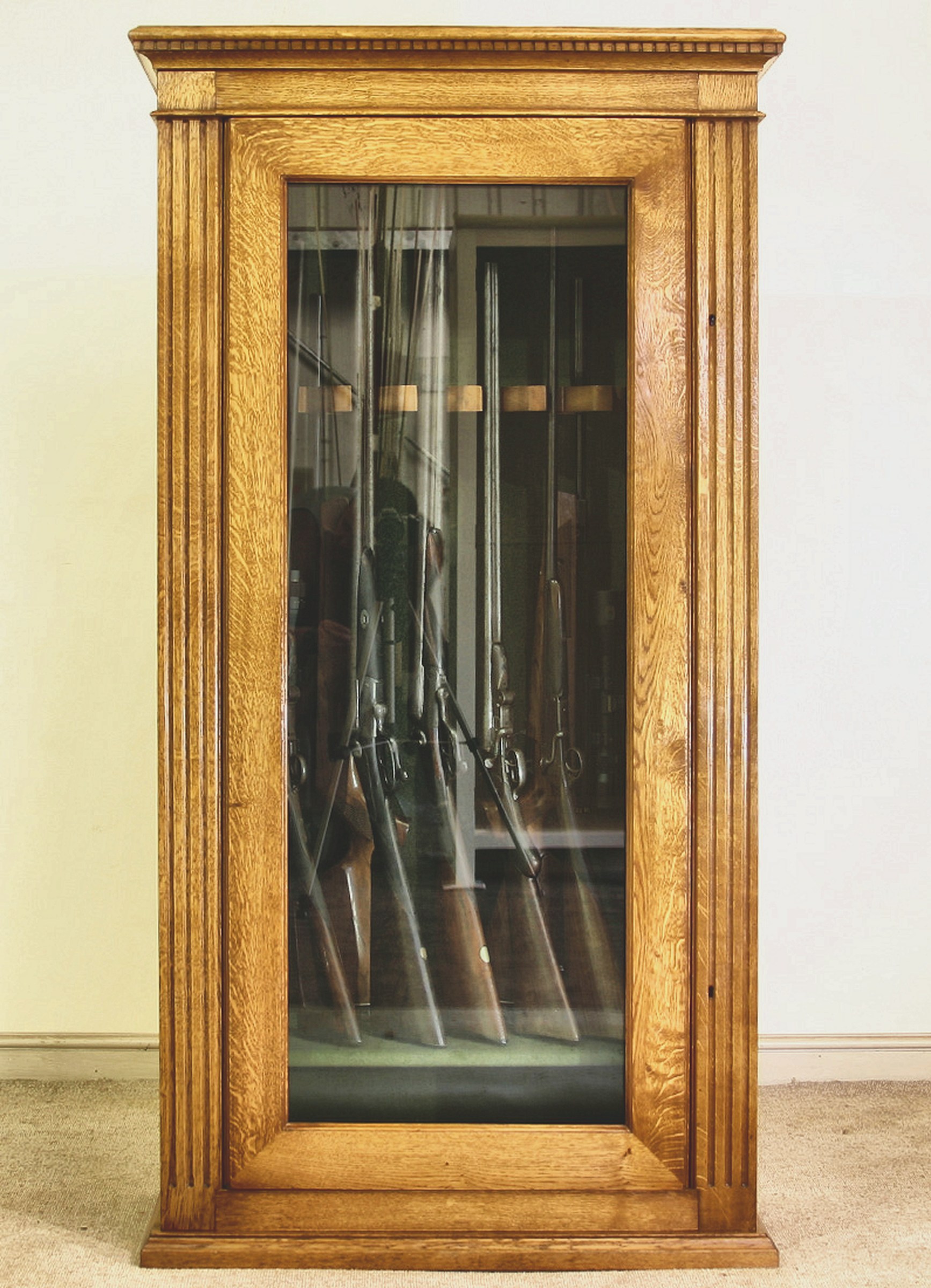
Bespoke gun cabinets
The specification in full. From £7,000 plus VAT, delivered and installed.
Fitted gun rooms
Steel lining, timber cladding and a clad firearms door. From £20,000 plus VAT.
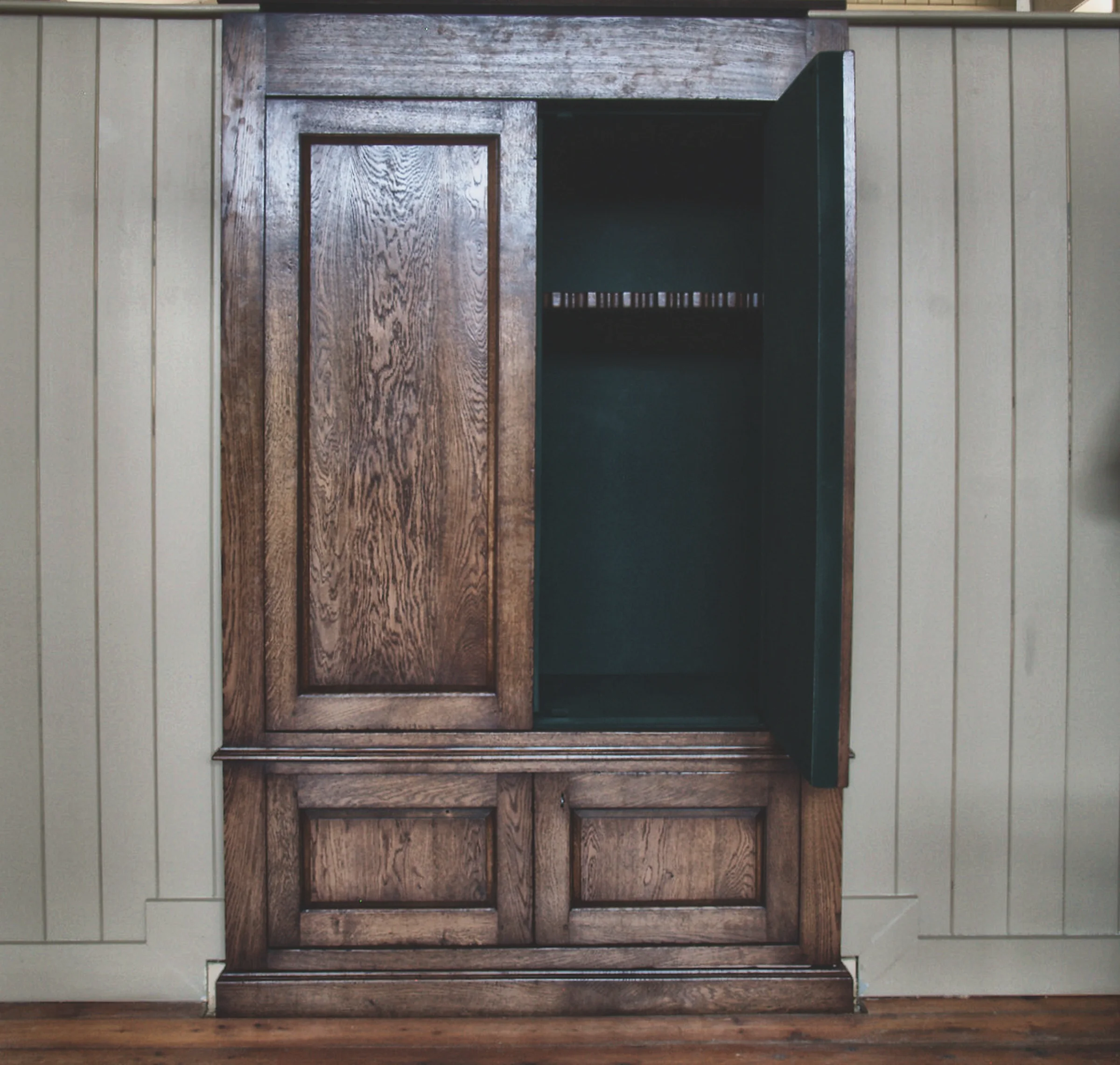
Concealed gun storage
Joinery built around a cabinet you already own.
This article is general information, not legal advice, and reflects the published position as at August 2026. Responsibility for the security condition on your certificate rests with you as the certificate holder, and the adequacy of any storage arrangement is a matter for your local police firearms licensing department.
If this is the sort of work you have in mind, there is more on how we approach bespoke studies, libraries and home office furniture, bespoke timber windows and timber wall panelling — all of it drawn, made, hand-finished and fitted by our own people from the workshop at Mickfield in Suffolk.