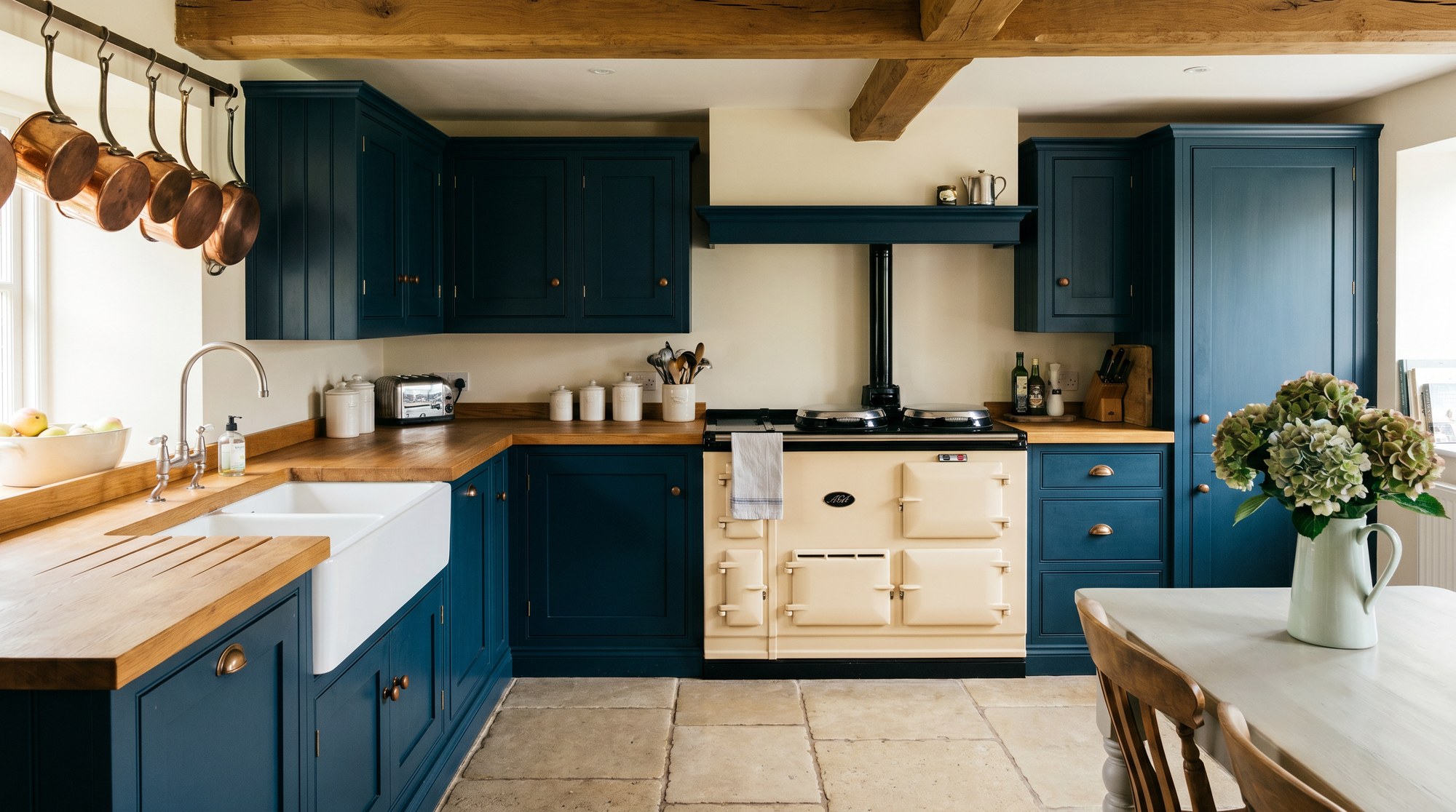
Bespoke farmhouse kitchens from Reeve & Co — handmade in our Suffolk workshop for high-end homes across London, the Home Counties and East Anglia.
Generous. Hard-working. Unpretentious.
The Farmhouse Kitchen
A farmhouse kitchen is a working room. Big sinks, big ranges, big tables. Painted timber, V-groove panels, honest hardware. We build farmhouse kitchens for farmhouses — drawn for how the room is already used, not styled to look the part. The detail comes from the joinery.
What a real farmhouse kitchen is
The point of a farmhouse kitchen is not to perform rustic charm. It is to support the daily traffic of the house: boots at the back door, pans on the range, flowers on the table, dogs underfoot and a sink that earns its keep.
That is why we begin with how the room works now, then refine the cabinetry, storage and finishes so the kitchen feels natural to the building instead of dressed up for it.
V-groove versus flat Shaker
V-groove panels bring shadow and texture to larger painted doors. Flat Shaker can be quieter. We use whichever best suits the age, utility and plain-spoken character of the room.
Dressers and freestanding pieces
Dressers, open shelves and freestanding-looking cupboards help a farmhouse kitchen avoid feeling over-fitted while still giving it the storage a working room needs.
Range walls and oversized sinks
Large ranges, Belfast sinks and broad preparation runs are often central to the plan, with joinery designed around use, cleaning and movement rather than display.
Materials and finishes
Farmhouse kitchens usually want materials that improve with use: painted timber, oak, stone, unlacquered or aged metalwork, honest knobs and latches, and finishes that can cope with family life without looking precious.
We keep the detailing straightforward, letting the proportions, panel treatment and joinery quality do the talking.
Frequently asked questions
What is the difference between V-groove and beaded Shaker?
V-groove creates a cleaner shadow line cut into the panel, while beaded Shaker introduces a small applied profile around it. The better choice depends on how plain or decorative the room wants to be.
Which worktops are strongest for a hard-working farmhouse kitchen?
Durability depends on how you cook and clean, but robust stone surfaces and well-chosen hardwoods are both common options for heavily used farmhouse rooms.
Do Belfast sinks suit this style?
Yes. Belfast and other fireclay sinks often sit naturally in farmhouse kitchens because they are practical, generous and visually simple.
Can the design work with an AGA?
Yes. We can plan cabinetry, clearances and adjacent work surfaces around an AGA or other range so the room remains practical as well as characterful.
What is the lead time?
Lead time varies with design complexity and the workshop programme, so we confirm timings once the brief and specification are properly established.
The working farmhouse kitchen
A farmhouse kitchen is defined less by a specific door profile than by a disposition: it is a room that works hard, holds a lot, and looks as if it has always been there. Painted cabinetry in traditional tones. A deep butler’s sink under a window. Open shelving for everyday crockery. A plate rack above the sink. A proper larder cupboard with ventilation and depth. An island big enough to do something useful on.
At Reeve & Co we make farmhouse kitchens that have those qualities and are built to last a long time. The cabinetry is solid timber and high-grade ply carcasses. The drawers are dovetailed. The paintwork is sprayed and finished in-house. There is nothing here that will peel, delaminate or fail after five years.
The elements of a farmhouse kitchen
Plate racks and open shelving
A painted timber plate rack above the sink is one of the most practical storage additions in a traditional kitchen. Open shelving for oils, jars and everyday items keeps worktops clear without losing access. We draw both into the kitchen design from the outset.
Larder and pantry units
A full-height larder cupboard — properly deep, properly lit, with pull-out shelves and internal organisation — does the work of many smaller wall units and gives the kitchen one of its strongest vertical elements.
Island and prep areas
A solid timber or stone-topped island is the working heart of a farmhouse kitchen. We design the island to the room: its height, its overhang, the placement of a prep sink, the depth of the storage beneath.
Butler’s sink and drainer
A deep ceramic butler’s sink set into a painted base run is a farmhouse kitchen constant. We design the surrounding cabinetry to give it the right housing — a proper drainer groove, a tiled splashback detail, a window reveal above where the room allows.
Range cooker and Aga housing
The cooker is the focal point. We draw the surrounding cabinetry — the overmantel, the open shelving to each side, the extractor housing — as a composed piece rather than a set of units placed around an appliance.
Dresser ends and display storage
A dresser end — glazed upper section, closed lower base — is a traditional farmhouse kitchen piece. We design standalone dressers and integrated dresser-end units depending on the room and the brief.
Finishes for a farmhouse kitchen
The palette of a farmhouse kitchen is traditionally based on soft, natural tones: off-whites, stone colours, aged greens, warm greys and occasional deeper tones for contrast. We work with Farrow & Ball, Little Greene, and bespoke-mixed colours. The right choice depends on the walls, the floor, the ceiling height and the level of natural light in the room.
Worktops in a farmhouse kitchen are typically solid timber — oak, iroko, walnut or treated pine — or honed natural stone: limestone, slate, brushed granite or Carrara marble. Polished stone and engineered quartz both work, particularly around a sink where durability matters. We advise on material selection based on how the kitchen is used and what the room needs visually.
Hardware is traditional: cup pulls, bin pulls, D-handles in painted steel, pewter or unlacquered brass. We do not use contemporary bar handles or push-to-open mechanisms in a farmhouse kitchen unless the brief specifically asks for a contrast between old and new.
Farmhouse kitchens across East Anglia
East Anglia has more farmhouses per square mile than almost anywhere else in England. The particular character of a Suffolk or Norfolk farmhouse — its beams, its proportions, its flint or brick exterior, its relationship between the house and the working buildings around it — makes it one of the most rewarding contexts in which to design a kitchen. The room has history. The furniture should acknowledge it.
We work in farmhouses across Suffolk, Norfolk, Essex and Cambridgeshire. Our experience with the building types — the low beams, the uneven floors, the Aga alcoves, the deep window reveals — means we resolve the design constraints before manufacture rather than improvising on site.
Farmhouse kitchen questions
What is the difference between a farmhouse kitchen and a Suffolk kitchen?
The terms overlap. The Suffolk kitchen style at Reeve & Co refers specifically to our classic painted in-frame cabinetry with a traditional East Anglian character. The farmhouse kitchen is a broader brief: it is defined by the room’s use and disposition — practical, generous, traditional — rather than a specific door profile. A farmhouse kitchen might be a Suffolk, a Shaker, or a combination.
Do you design around an existing Aga?
Yes. We draw the kitchen around the appliance, not the other way round. If you have an existing Aga in an alcove, we design the cabinetry to give it the right setting — including the surrounding shelving, the extraction and the overmantel if the room suits one.
Can a farmhouse kitchen work in a converted barn?
Yes — and we make them regularly. Barn conversions have large volumes, high ceilings and exposed structural timber that suit the character of a farmhouse kitchen well. The design typically works at a larger scale than a cottage kitchen: taller wall units, a bigger island, generous plate racks. The materials and finish choices respond to the exposed structure and the volume of the space.
Making a farmhouse kitchen feel authentic
A farmhouse kitchen should feel useful first. It should take the pressure of daily cooking, dogs, muddy doors, family meals, laundry overflow, vegetable boxes and visitors without feeling too precious. That does not mean rough or casual making; it means the design has to be honest about how the house is used.
We often begin with the working parts: cooker, sink, larder, fridge, dishwasher, bins, preparation surface and table or island. Once those are right, the character details can be added with restraint. A plate rack, dresser, oak drawer, butler sink or open shelf should earn its place rather than simply signal farmhouse style.
The difference between a convincing farmhouse kitchen and a staged one is usually proportion. The cabinetry should sit into the room with enough confidence to be noticed, but enough restraint to look as if it belongs.
Painted finishes age well
A properly specified painted finish can be refreshed over time and suits kitchens that will be lived in for many years.
A table may beat an island
Some farmhouse rooms want a working table more than a fixed island, particularly where circulation and age of the house matter.
Pantries reduce clutter
A larder cupboard or pantry space keeps appliances, dry goods and everyday mess away from the main elevations.
Utility links are valuable
A nearby boot room or utility can carry the less glamorous storage so the kitchen remains calm.
Local kitchen work, national joinery standards
For bespoke kitchens our main local focus is Suffolk, Essex, Norfolk and Cambridgeshire, but Reeve & Co also fits high-end kitchens and fitted furniture nationally. We are regularly working in London on residential joinery projects, so the workshop is used to delivering the same level of detail for townhouses, country homes, apartments and larger private houses well beyond East Anglia.
Have a farmhouse kitchen in mind?
If you are planning a working kitchen for a farmhouse, cottage or country house, we can design it around the life of the room rather than a decorative formula.
From our Suffolk workshop we design, make and install bespoke farmhouse kitchens for high-end homes across London, the Home Counties and East Anglia. Every commission is made to measure and finished to a furniture-quality standard. To discuss bespoke farmhouse kitchens, get in touch or explore our case studies.
To provide the best experiences, we use technologies like cookies to store and/or access device information. Consenting to these technologies will allow us to process data such as browsing behaviour or unique IDs on this site. Not consenting or withdrawing consent, may adversely affect certain features and functions.
Functional
Always active
The technical storage or access is strictly necessary for the legitimate purpose of enabling the use of a specific service explicitly requested by the subscriber or user, or for the sole purpose of carrying out the transmission of a communication over an electronic communications network.
Preferences
The technical storage or access is necessary for the legitimate purpose of storing preferences that are not requested by the subscriber or user.
Statistics
The technical storage or access that is used exclusively for statistical purposes.The technical storage or access that is used exclusively for anonymous statistical purposes. Without a subpoena, voluntary compliance on the part of your Internet Service Provider, or additional records from a third party, information stored or retrieved for this purpose alone cannot usually be used to identify you.
Marketing
The technical storage or access is required to create user profiles to send advertising, or to track the user on a website or across several websites for similar marketing purposes.