
Introduction
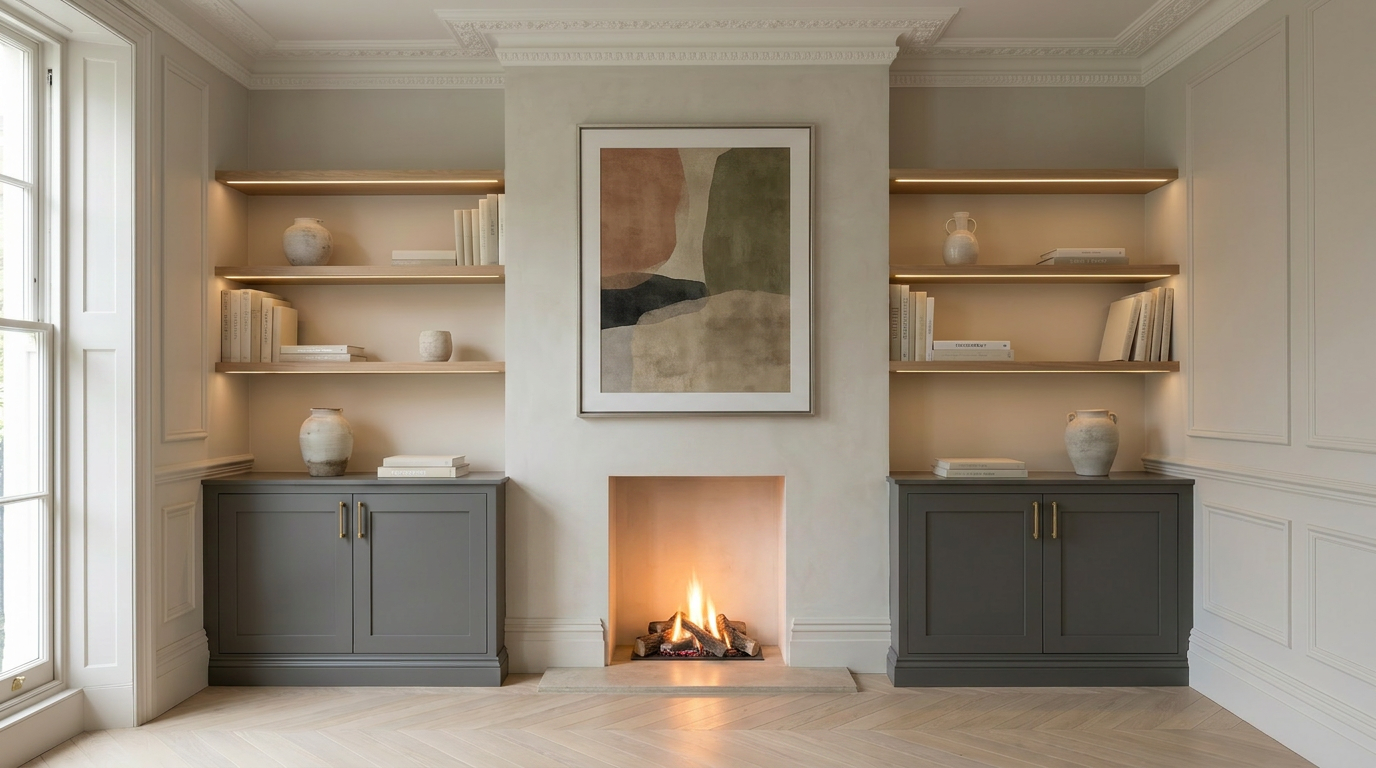
Alcove joinery looks simple because the space is already defined: two recesses, often either side of a chimney breast, waiting to become storage, shelving, display or AV housing. In practice, it is one of the details that can quietly lift or weaken an interior scheme.
For interior designers, the opportunity is not only to fill a gap. Bespoke alcove joinery can correct awkward proportions, frame a fireplace, hide services, introduce lighting, balance a room and give a client useful storage without making the space feel heavy.
At Reeve & Co, we design, draw, make and install bespoke fitted joinery from our Suffolk workshop for architects, interior designers and private clients across London, the Home Counties and East Anglia. This guide sets out what to resolve before workshop drawings begin, so alcove joinery supports the design intent rather than becoming a late-stage compromise.
Why alcove joinery deserves early specification
Alcoves are often treated as “minor joinery”, but they touch several design decisions: room symmetry, fireplace setting, storage planning, electrical coordination, decorative finishes and installation sequencing. If those items are left until after finishes are chosen, the joinery can end up forcing decisions rather than supporting them.
For designers working to a formal project structure, it helps to align joinery decisions with the wider project programme. The RIBA Plan of Work organises projects from Strategic Definition through Technical Design, Manufacturing and Construction, through to Use, giving interior designers a useful framework for managing information exchange and procurement (BIID).
The practical point is simple: by the time technical design is under way, the joinery partner should already know the design intent, finish intent and the client’s storage needs. Alcove joinery may be compact, but it still benefits from early coordination.
Start with the room, not the unit
Good alcove joinery begins with the room elevation. Before deciding door style or shelf thickness, resolve what is wanted for the room as a whole.
Key questions to settle early:
- What should the fireplace wall become? A quiet architectural elevation, a library wall, a media wall, a display wall or a storage-led family room?
- Should the two alcoves match? Symmetry suits formal reception rooms, but asymmetry can work where one side needs AV equipment, a desk, a drinks cabinet or additional storage.
- How much visual weight is acceptable? Full-height cupboards maximise storage, while base cupboards with open shelving keep the wall lighter.
- What should be hidden? Routers, speakers, AV boxes, children’s items, paperwork, logs, books and decorative objects all need different depths, shelf spacings and ventilation.
- How does the joinery meet existing architecture? Skirting, cornicing, picture rails, dado rails, fireplaces and uneven plaster should be drawn into the design, not discovered during installation.
This is where a specialist joinery partner adds value for designers. A concept sketch can show the design intent and confirm the spatial relationships; the joinery partner can then turn that intention into workable dimensions, junctions and manufacturing decisions.
Survey: the detail that protects the design
Most alcove walls are not perfectly square, plumb or symmetrical. This is especially true in Victorian and Edwardian properties across London, where chimney breasts, plasterwork and old floors can vary noticeably across the elevation.
As a guide, a current London alcove joinery market guide notes that Victorian properties can vary by 20–50mm across an alcove’s width and recommends measuring each alcove at several heights rather than taking one width and assuming it applies across the whole recess (Noba & Stod).
For interior designers, the survey should capture:
- Overall room dimensions and ceiling height.
- Each alcove width at floor level, mid-height and near ceiling height.
- Alcove depth relative to the chimney breast face.
- Skirting, dado, picture rail and cornice positions.
- Socket, switch, radiator, pipe, vent and AV locations.
- Fireplace projection and hearth dimensions.
- Wall condition, damp risk and any historic fabric constraints.
- Access route, parking, floor protection and installation restrictions.
The result should be a proper elevation and plan, not just a shopping list of cabinets. Alcove joinery that is built to a proper survey rarely needs adjusting once installed.
Choosing the right configuration
There are four common approaches to bespoke alcove joinery, and each suits a different design outcome:
| Configuration | Best for | Design considerations |
|---|---|---|
| Floating shelves only | Light-touch display, books, informal living rooms | Needs careful fixing, wall condition checks and well-proportioned shelf thickness. |
| Base cupboards with shelves above | Reception rooms, family rooms, studies | Good balance of hidden storage and display; works well around chimney breasts. |
| Full-height cupboards | Bedrooms, offices, boot rooms, compact storage areas | Maximises capacity but can feel heavy if door proportions and shadow gaps are not handled well. |
| Full-height library or display joinery | Formal rooms, libraries, studies | Requires detailed thinking around lighting, shelf spans, object sizes and ladder or access needs. |
Market guidance for London suggests base cupboards with shelving above are one of the most common configuration choice for alcoves either side of chimney breasts (Noba & Stod). That does not mean it is always the best answer. In a high-end scheme, the correct configuration should come from the room’s use, the client’s storage needs and the designer’s intended hierarchy.
Materials and finishes: specify what the eye and hand will notice
Not every part of an alcove unit needs the same material. In many painted schemes, the best specification uses engineered material for carcasses with solid timber, tulipwood or hardwood lippings for visible edges, frames and doors.
Designers should agree:
- Carcass material — often moisture-resistant MDF, birch plywood or veneered board depending on finish, budget and use.
- Door construction — flat slab, shaker, raised-and-fielded, reeded, fluted, framed or veneered.
- Shelf construction — solid timber, veneered board, lipped board or torsion-box construction for deeper spans.
- Finish — spray-painted, hand-painted, lacquered, oiled, stained, veneered or specialist decorative finish.
- Ironmongery — exposed knobs, recessed pulls, push-to-open, concealed hinges, soft-close drawers or pocket-door mechanisms.
- Durability requirements — family use, rental use, display-only use or commercial-grade wear.
The British Woodworking Federation describes itself as the UK trade association for the woodworking and joinery manufacturing industry, providing technical, regulatory and specification guidance to more than 500 members and supporting good practice across the sector. For interior designers, that reinforces the importance of treating fitted joinery as a specified element, not just site carpentry.
Lighting, sockets and AV need to be designed in
Alcove joinery often becomes the point where lighting design, AV, electrical work and furniture design intersect. If those are not resolved early, cables become visible, routers overheat, sockets sit in the wrong place and shelves get drilled after fitting.
Resolve these details before manufacture:
- LED shelf lighting location, colour temperature and control method.
- Driver, transformer and access panel positions.
- Socket and data requirements inside cupboards.
- Cable routes for TVs, speakers, lamps and routers.
- Ventilation for AV equipment.
- Door clearance around plugs and trailing leads.
- Whether the joinery needs removable backs or service access.
The best result is almost invisible. The client notices the atmosphere, not the cable route.
Listed and period properties: protect character first
Many high-end residential projects involve period houses, conservation areas or listed buildings. Alcove joinery that is fixed, chased or built against historic fabric needs careful thought, and the team should check whether any fixings, chasing, removals or alterations affect historic fabric.
Historic England advises that if you want to alter or extend a listed building in a way that affects its character as a building of special architectural or historic interest, you need to apply for Listed Building Consent from the local planning authority, and recommends checking first with the local planning authority to confirm whether consent is needed and what may be acceptable.
For interior designers, that means:
- Do not assume internal work is exempt.
- Avoid cutting through original mouldings, panelling or plasterwork without advice.
- Design reversible junctions where possible.
- Record existing details before works begin.
- Allow for conservation input before finalising workshop drawings.
Reeve & Co already works on period and listed-building-sensitive projects, so the conversation should start early when a scheme includes original joinery, historic plaster, chimney pieces or unusual existing fabric.
Cost and lead-time expectations
Every project should be quoted from drawings, specification and survey information, not from a general price list. That said, designers need early budget ranges to guide clients before detailed design begins.
Recent London market guidance gives broad alcove joinery ranges of around £1,200–£6,000+ per pair, with full-wall units reaching £5,000–£8,000+ depending on complexity, materials and finish (Noba & Stod). The same guide suggests a typical total timeline of 4–8 weeks, with design and manufacture often taking 2–4 weeks and installation 1–3 days depending on method and complexity (Noba & Stod).
For high-end work, the factors that usually affect cost are:
- Complexity of the room and survey.
- Whether the units are workshop-made, site-built or pre-finished.
- Door style, moulding profile and frame detail.
- Painted, stained, veneered or specialist finish.
- Lighting, AV access and concealed services.
- Drawer boxes, internal fittings and ironmongery.
- Matching existing architectural details.
- Access, parking, protection and installation constraints.
The safest approach is to set an early budget allowance, then refine once the design intent, drawings and specification are confirmed.
What a designer should give the joinery partner
A good joinery brief does not need to be complicated. It should make the design intent clear enough for the joinery partner to advise on specification and prepare drawings, without requiring the designer to resolve every technical detail.
Useful information includes:
- Design concept, moodboard or room elevation.
- Site photos and any existing survey drawings.
- Intended use for each cupboard, shelf and display area.
- Preferred door style, finish direction and hardware language.
- Paint colours, timber references or sample requirements.
- Electrical, AV and lighting requirements.
- Relevant heritage, listed-building or conservation constraints.
- Programme, access dates and dependency on other trades.
- Client expectations around budget, finish level and maintenance.
From there, the joinery partner should produce measured drawings, flag constraints, advise on materials and confirm that the design can be manufactured, finished and installed cleanly.
The Reeve & Co approach
Reeve & Co works with private clients, architects, interior designers and main contractors, designing and making bespoke fitted joinery in our Suffolk workshop before fitting on site with our site team (Reeve & Co). For interior designers, that gives one joined-up route from design intent to workshop drawings, manufacture, finishing and installation.
For alcove joinery, we can work from your design package or develop the detail with you. That might mean matching an existing period moulding, producing a quieter contemporary detail, integrating lighting or coordinating a media wall alongside study joinery.
The aim is simple: alcove joinery that looks as if it belongs to the room, performs properly for the client and supports the overall scheme.
Planning an alcove joinery package?
If you are an interior designer specifying alcove cupboards, display shelving, living-room storage, media walls or study joinery as part of a high-end residential package, Reeve & Co can help develop the detail before it reaches site.
Send drawings, photos or an outline brief to the workshop and we can advise on specification, survey requirements, programme and next steps.
Discuss a bespoke joinery project: Contact Reeve & Co
Related reading: Why Architects and Interior Designers Need a Bespoke Joinery Partner
About the workshop: About Reeve & Co