
Timber, Finishes and Antiquing
Oak, walnut, mahogany or hand-painted hardwood, French polished, hand-oiled, painted or antiqued — all finished in our own spray booth, by our own polisher.
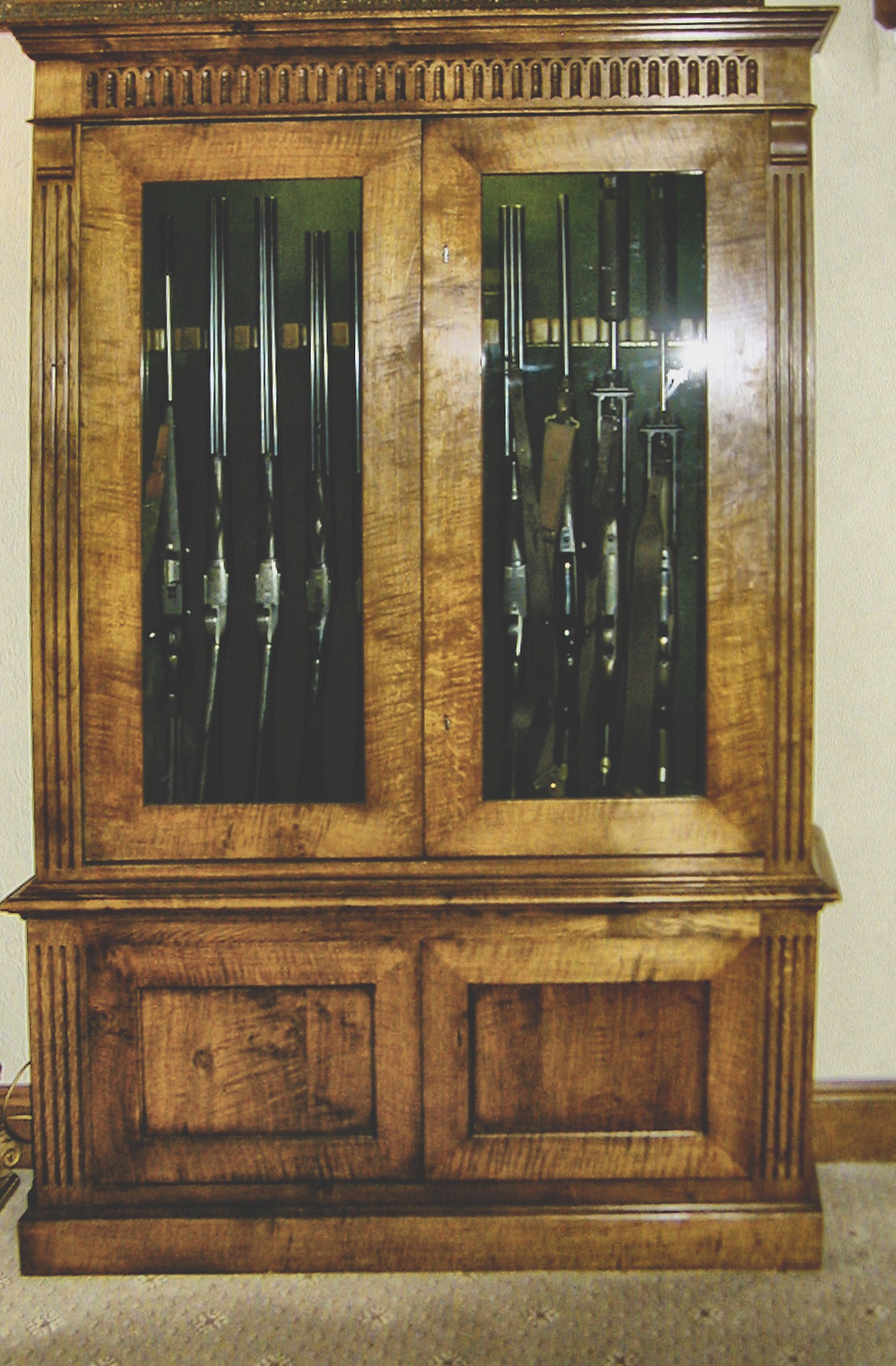
The three timbers, and how they behave
Oak is the workhorse and the one we are asked for most. Quarter-sawn it shows medullary ray — the silvery figure that runs across the grain — and it is hard enough to take the knocks a boot room delivers. It also ages well, darkening rather than tiring.
Walnut is the show timber. Book-matched across a pair of doors, where two leaves from the same board are opened like a book so the figure mirrors about the centre joint, it is the reason people stop and look at a cabinet. It is the most expensive of the three and the most rewarding.
Mahogany suits a formal room, and it takes French polish better than either of the others. In a study or a library with older furniture it very often reads as the only right answer.
Where a room is already painted, we make in hardwood and hand-paint it, which lets a cabinet join an existing scheme rather than compete with it. A painted cabinet is not a cheaper cabinet — the carcass and the steel are identical — it is a different decision about the room.
Book-matching, and why it has to be decided early
Book-matching is a machining decision, not a finishing one. The boards have to be selected together, from the same log where possible, and cut and kept in sequence through the workshop.
That means it cannot be added afterwards. If a pair of doors is going to mirror, the timber is chosen for it before anything is cut, and the offcuts from those boards are kept for the mouldings so the whole piece reads as one.
It is the clearest example of why a bespoke cabinet is a different object from a bought one. Nobody selects boards in pairs for a production run.
Antiquing, and when a new cabinet should not look new
A new cabinet in a house full of old furniture can look wrong precisely because it is too perfect. Crisp arrises, an even colour and a flawless surface are exactly what two hundred years of use removes.
Antiquing addresses that. Edges are softened where hands and sleeves would have worn them, the colour is broken up so it is not uniform, and the surface is given the depth that age produces. Done well it is invisible as a technique — the piece simply does not announce itself as new.
Done badly it looks like distressed furniture, which is a different thing entirely and usually worse than leaving it alone. It is skilled work and it is worth seeing examples before committing to it.
We would generally suggest it where a cabinet is joining a room of genuinely old furniture, and advise against it in a contemporary interior where a crisp new piece is the point.
Finishing is done here
All finishing is carried out in our own spray booth and prep room, by our own polisher, rather than sent out to a third party.
That matters for consistency across a commission. Where a cabinet, a drawer bank and a run of panelling all have to match, they are finished by the same person, in the same conditions, from the same materials — which is far harder to guarantee when the work is subcontracted and finished in batches.
It also means we can match an existing piece. Where a cabinet is joining furniture already in the room, we work to a sample and adjust until it is right, rather than picking the nearest standard colour from a chart.
Timbers and finishes
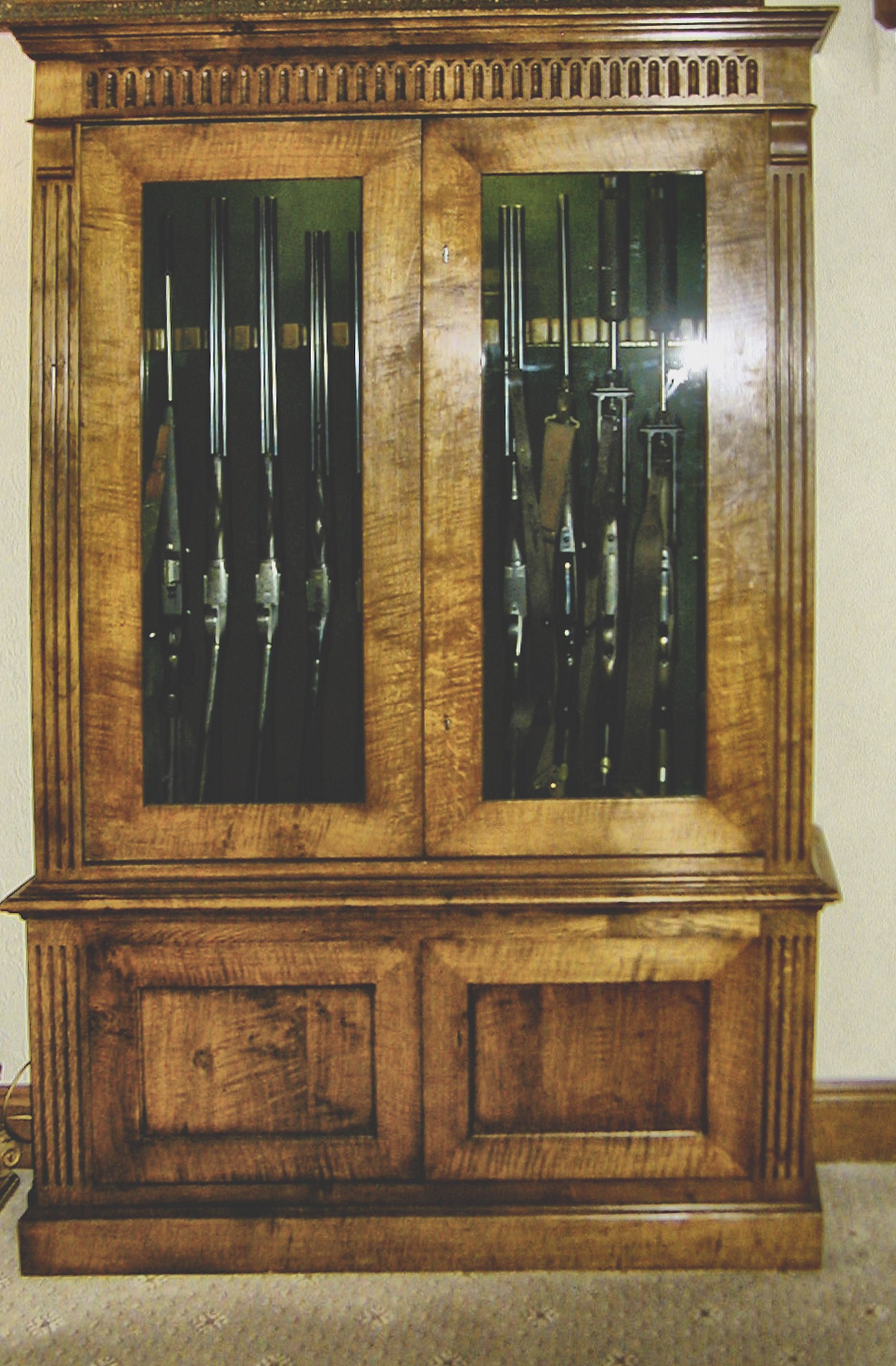
Antiqued figured oak
Softened edges and broken colour so it sits with older furniture.
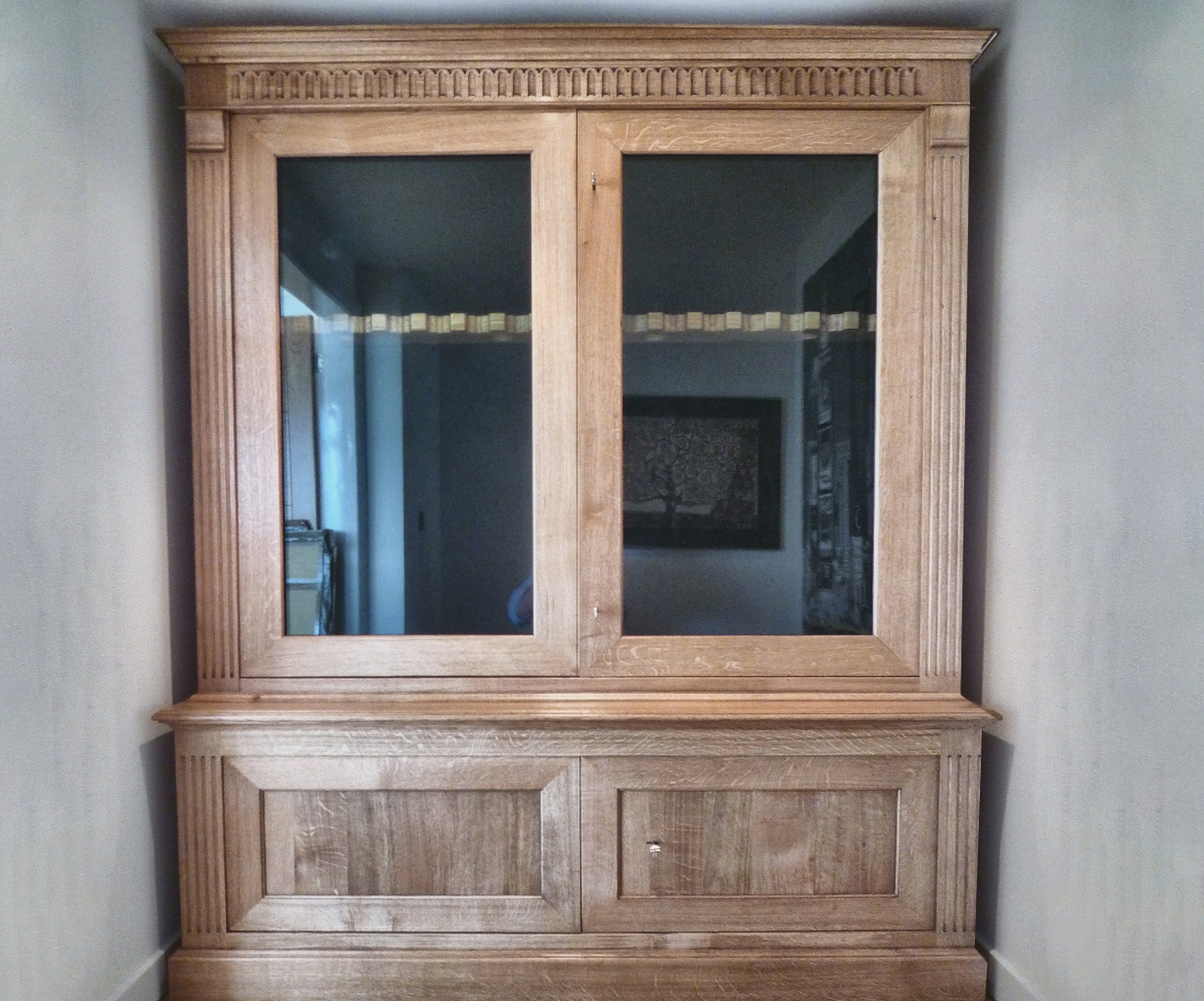
Limed oak
A paler treatment, suited to a lighter room.
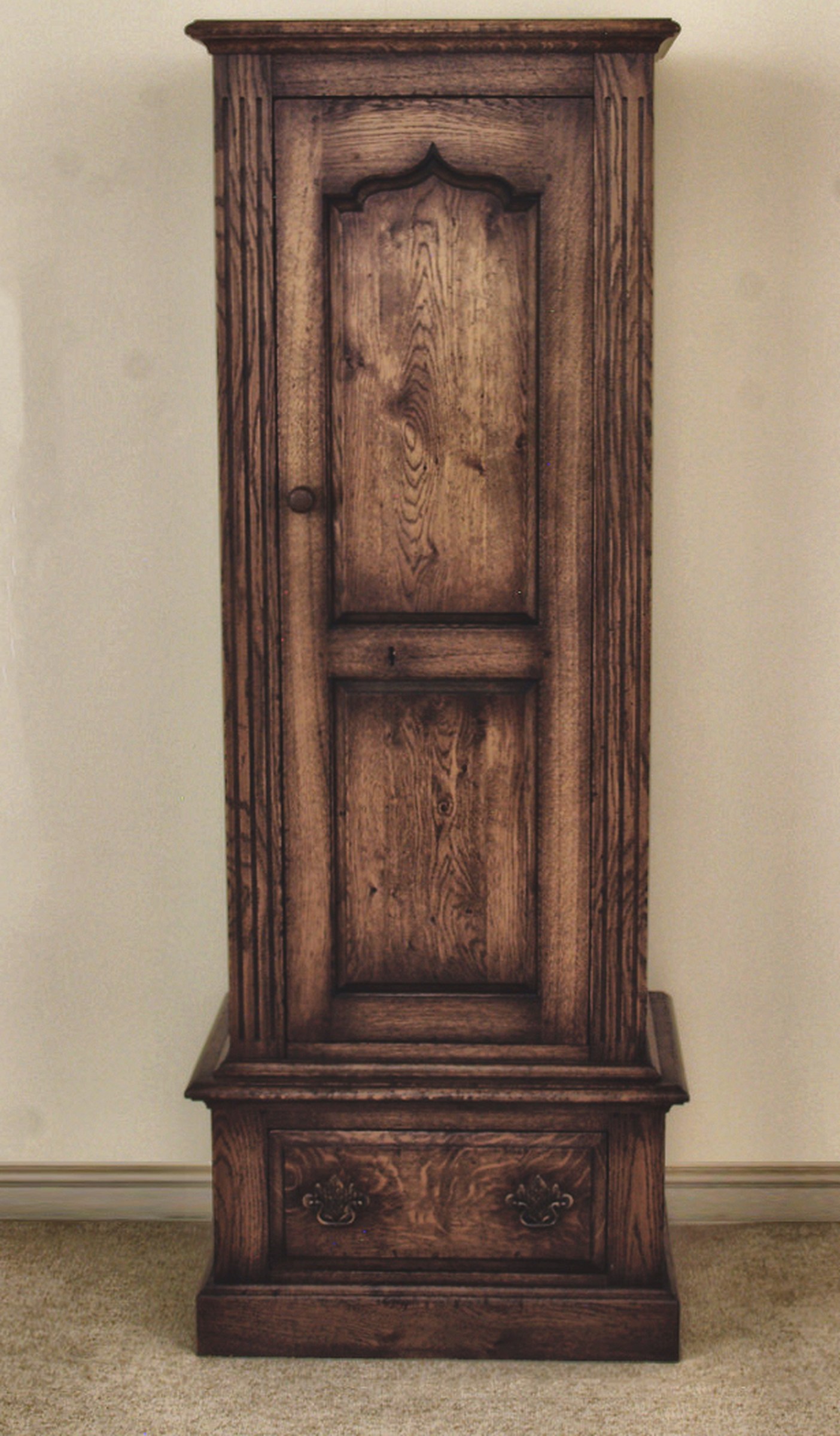
Oak, hand-oiled
Quarter-sawn oak with an arched fielded panel and carved plinth.
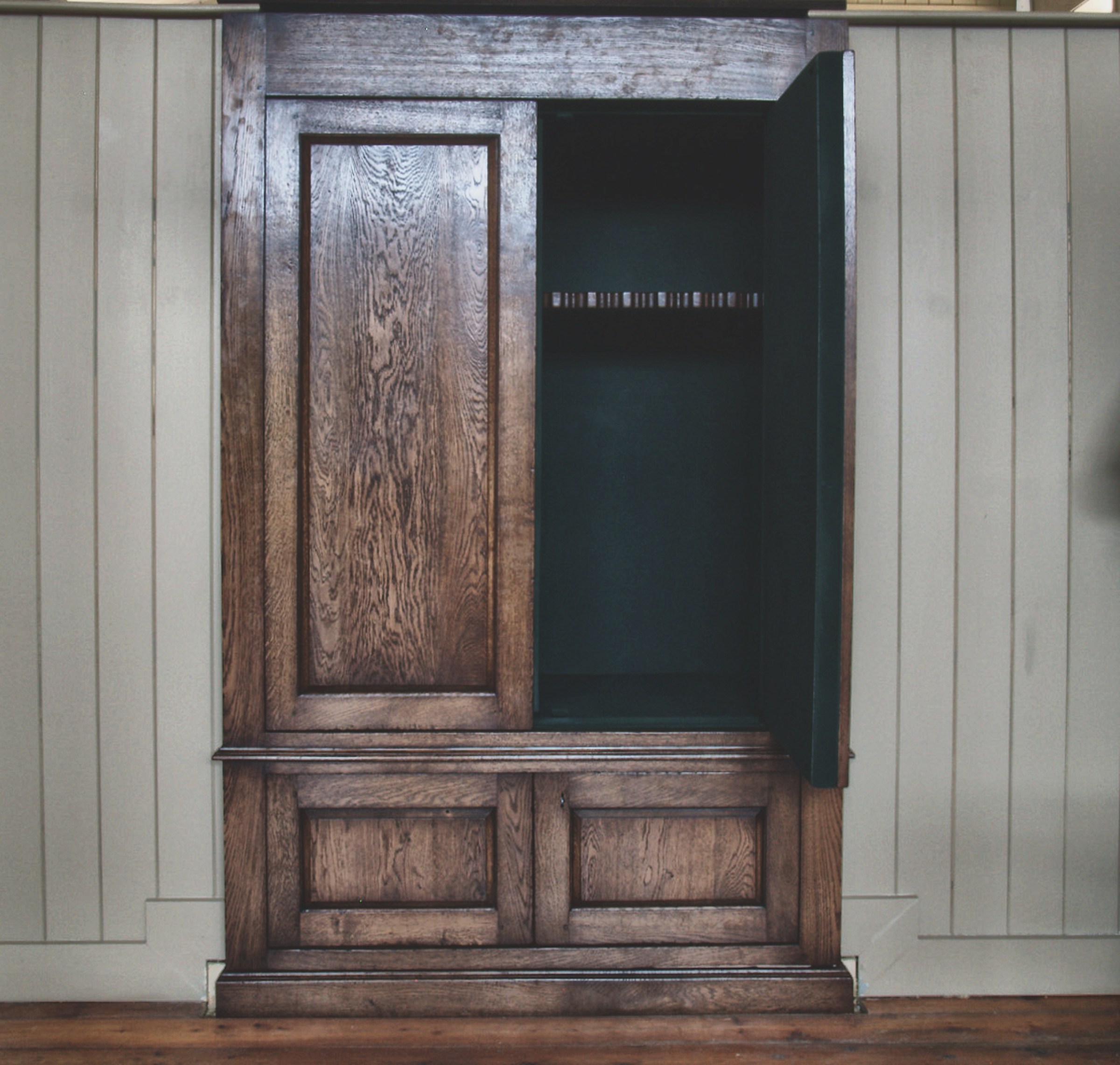
Against paintwork
Timber against a painted panelled ground, matched at the mouldings.
Questions we are asked
Which timber should I choose?
Usually the room decides. Oak for a working room that takes knocks, walnut where the cabinet is meant to be admired, mahogany for a formal study under French polish. If there is furniture already in the room, matching it is generally the right instinct.
Can you match existing furniture or panelling?
Yes, and it is ordinary work for us. We work to a sample and adjust the finish until it is right. Send photographs and, if you can, let us see the piece itself.
Is a painted cabinet cheaper?
No. The carcass, the steel, the locks and the fixings are identical, and hand-painting is skilled work in its own right. Painted is a decision about the room rather than about the budget.
How do I look after the finish?
Very little is needed. Keep strong direct sunlight off it, dust rather than polish aggressively, and avoid silicone-based sprays on French polish. We hand over care notes with every commission.
All gun cabinets
The overview: what we make, what it costs and how a commission runs.
The specification
Steel, anti-bandit glass, locks and fixings, in full.
What the rules actually say
No law requires a gun cabinet. What the Firearms Rules do require.
Send us your gun list
Send us your gun list and a photograph of the room, and we will come back with a drawing and a price. From £7,000 plus VAT, delivered and installed anywhere in the UK.
Start a commissionFurther reading: gun room security, and what the rules actually say. Responsibility for the security condition on your certificate rests with you as the certificate holder, and the adequacy of any storage arrangement is a matter for your local police firearms licensing department.