
TV Media Bespoke Units
Bespoke media units, TV walls and storage designed to conceal technology while improving the architecture of the room.
Tv media bespoke from Reeve & Co — handmade in our Suffolk workshop for high-end homes across London, the Home Counties and East Anglia.
Bespoke TV and media joinery by Reeve & Co – fitted media walls, integrated television cabinetry, AV storage and combined bookcase and media units designed around the technology requirements of a room without allowing technology to dominate it. Made in our Suffolk workshop, installed across London, the Home Counties and the wider UK.
A media wall designed as furniture
A television on a white wall is not a design solution. A TV and media unit that has been designed as a piece of furniture – with the screen positioned at the correct height for the room, the AV equipment housed in ventilated and accessible compartments, the cabling concealed from the outset and the surrounding cabinetry scaled and detailed to read as part of the room’s architecture – is a fundamentally different proposition.
Reeve & Co designs and makes bespoke TV and media joinery for private homes across London, the Home Counties and the wider UK. Our media cabinetry ranges from a single fitted TV cabinet flanked by shelving and cupboards in a sitting room to a full chimney-breast media wall in an open-plan apartment, designed as a combined media, display and storage piece with concealed cabling and integrated surround-sound provision. The common thread is that the technology serves the room rather than the room serving the technology.
Media joinery types and configurations
Fitted media wall
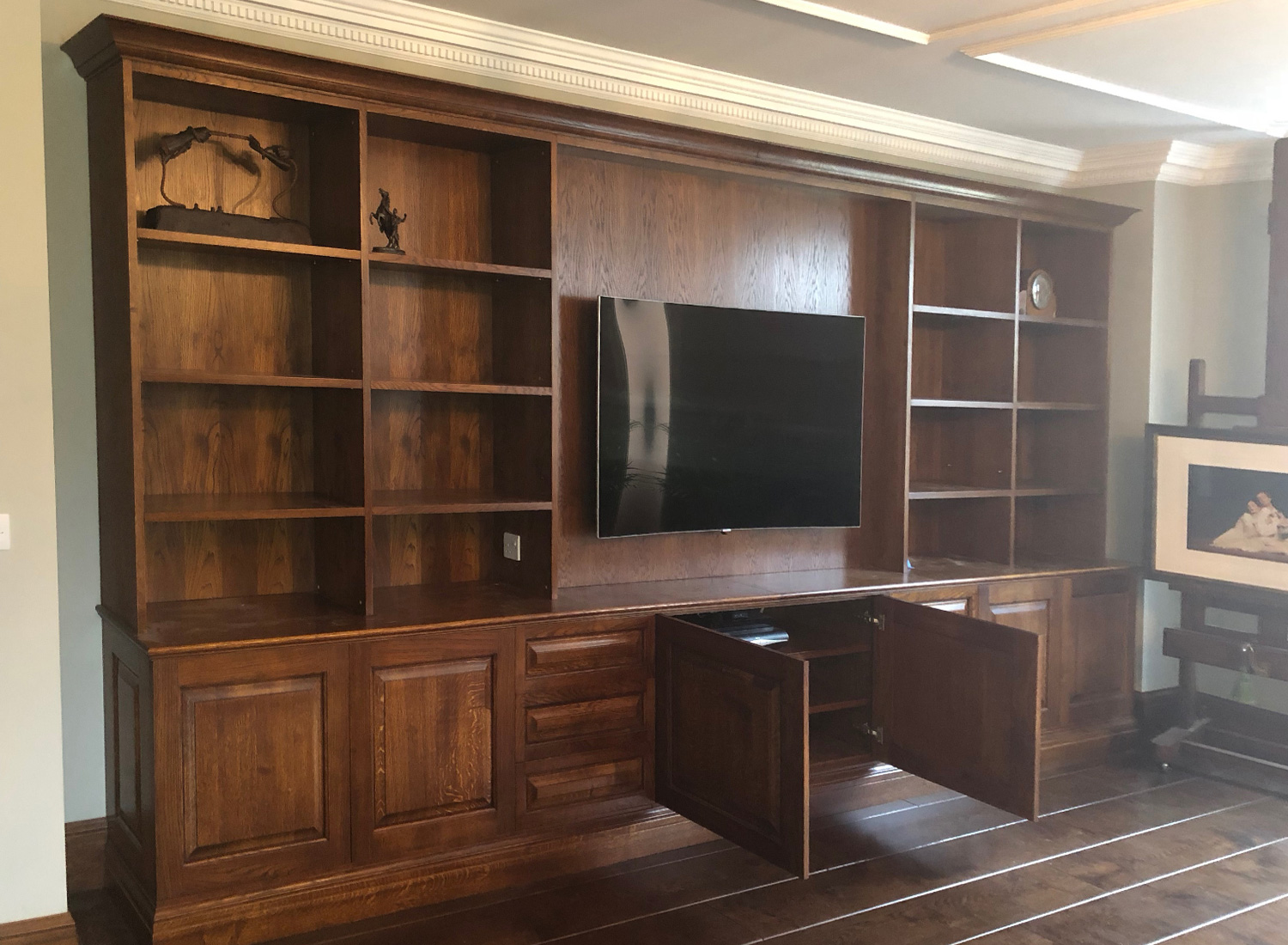
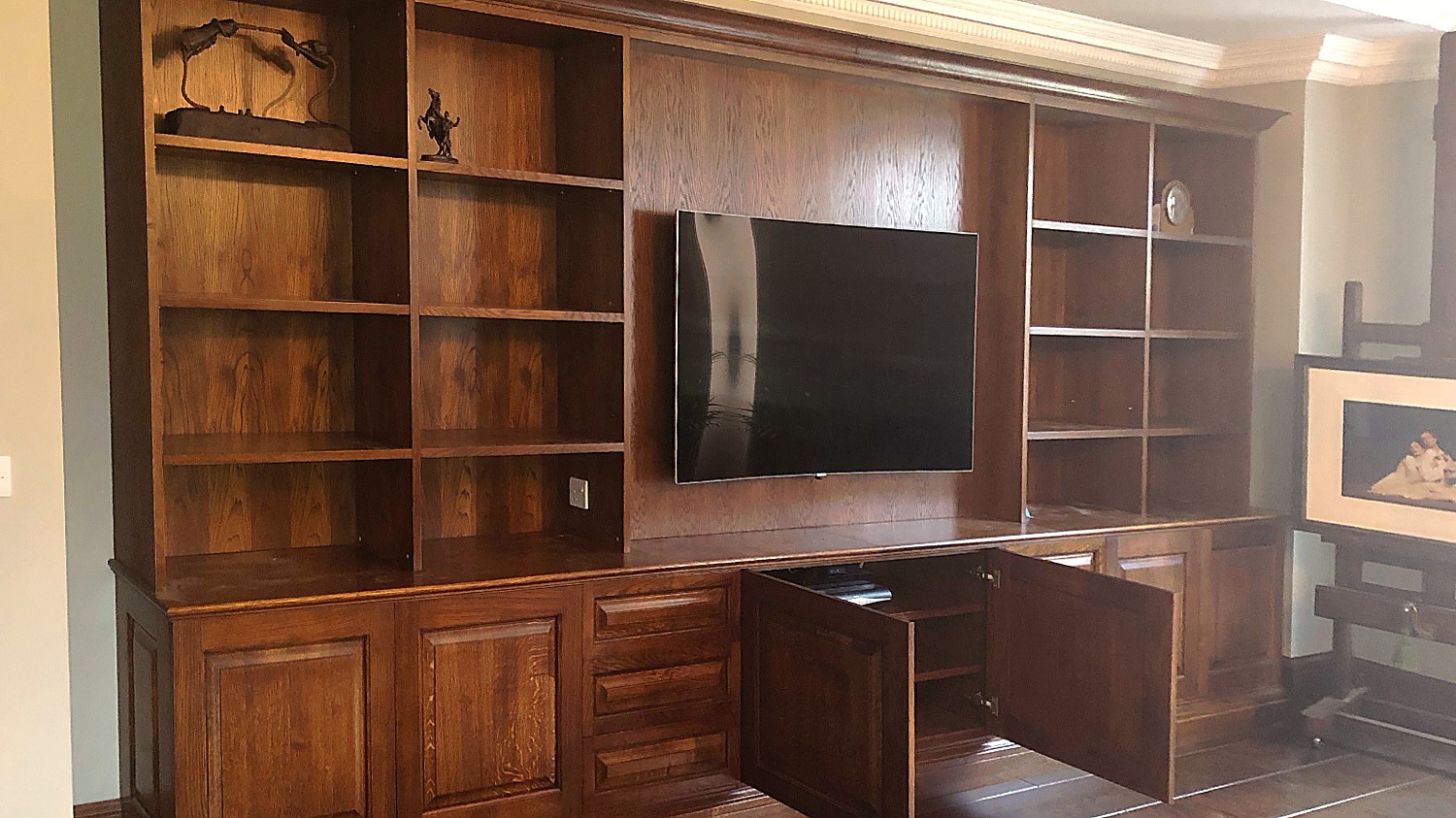
A full-width or floor-to-ceiling media wall combining the TV bay, flanking shelving or closed storage and a concealed base unit for AV equipment. Designed in elevation to fill the wall thoughtfully rather than leave awkward gaps.
Chimney-breast media unit
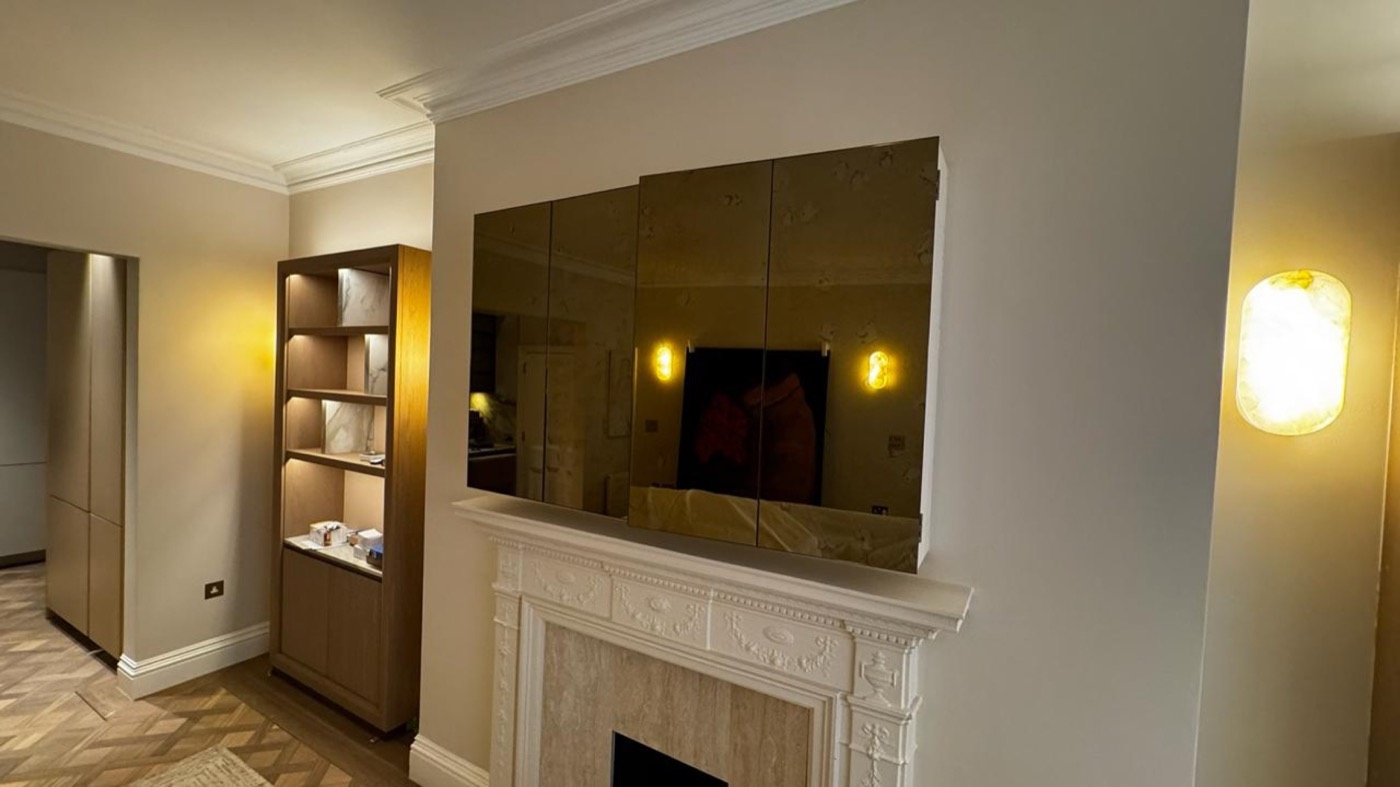
The TV positioned above or within the chimney breast, with flanking alcove bookcases and a base AV unit below. The most common configuration in period London rooms, and one that requires careful proportioning to avoid looking temporary.
Combined bookcase and media cabinet
A fitted bookcase that incorporates a concealed TV bay and AV compartment – the screen hidden behind a pair of cabinet doors or a motorised panel when not in use. A practical solution for sitting rooms where the television should not dominate.
Media and gaming rooms
Fitted joinery for dedicated media rooms: acoustic panels within a cabinetry frame, concealed projector housing, fitted seating surrounds and cable-managed equipment bays. Designed to function precisely without looking purely functional.
Fitted TV cabinet, free-standing style
A piece of fitted cabinetry designed to look like furniture rather than built-in units. A base cabinet with TV above, flanked by open shelving or glazed display – proportioned as a single furniture piece rather than a run of standard units.
Commercial and hospitality media joinery
Fitted AV cabinetry for private members’ clubs, hotel suites, private cinemas and commercial spaces where the standard of finish needs to match a high-end residential level of quality.
Cable management and AV integration
The most common failure in fitted media furniture is cable management treated as an afterthought. Visible HDMI cables, exposed power strips and inaccessible equipment bays are signs that the joinery was not designed around the technology it houses. We resolve cable management at the drawing stage: routing cables through the structure of the cabinetry, incorporating ventilated equipment bays with pull-out shelving for easy access, and designing in-wall cable routes in co-ordination with the client’s electrician and AV installer.
We work alongside AV installers and acoustics consultants where the brief requires it. Our role is to produce the cabinetry that makes their work invisible – so the room functions as intended and looks as though the technology were always part of it.
Designing a media wall that reads as furniture, not as technology
The principal design challenge of a fitted media wall is that it is organised around a specific and often visually dominant object – a television – that the furniture is nonetheless trying not to emphasise. The approaches are broadly three. The first is to house the screen in a cabinet with closing doors, so that it disappears when not in use and the cabinet reads as a sideboard or dresser. This works well for screens up to approximately 65 inches and in rooms where the television is used intermittently rather than as the primary activity.
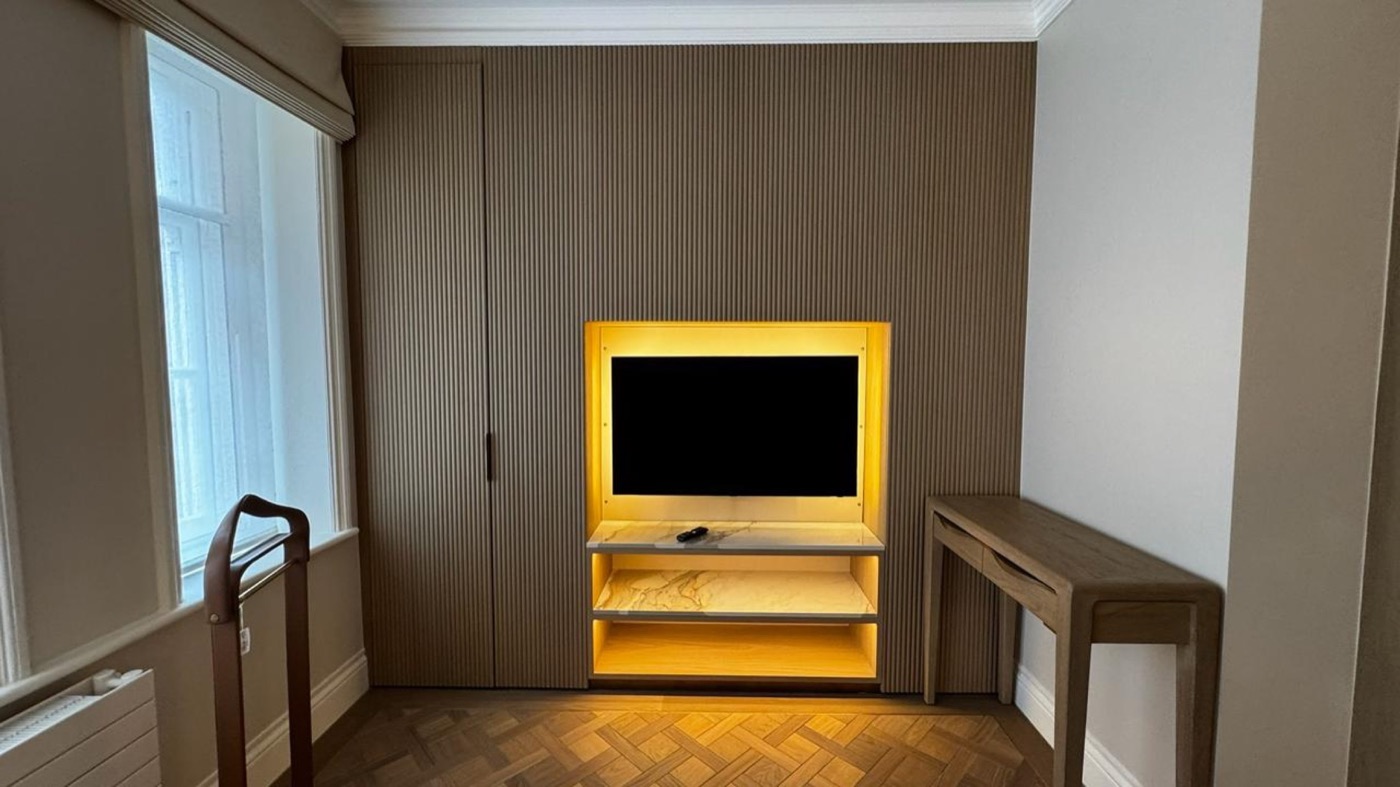
The second approach is to acknowledge the screen by designing the cabinetry around it deliberately – a framed recess at the correct height, flanking shelving or cupboards that balance the visual weight of the screen, and a base unit below that houses the AV equipment and provides a surface. The screen is present but the furniture governs the composition. This is the most common approach for open-plan living rooms, family rooms and sitting rooms in London apartments.
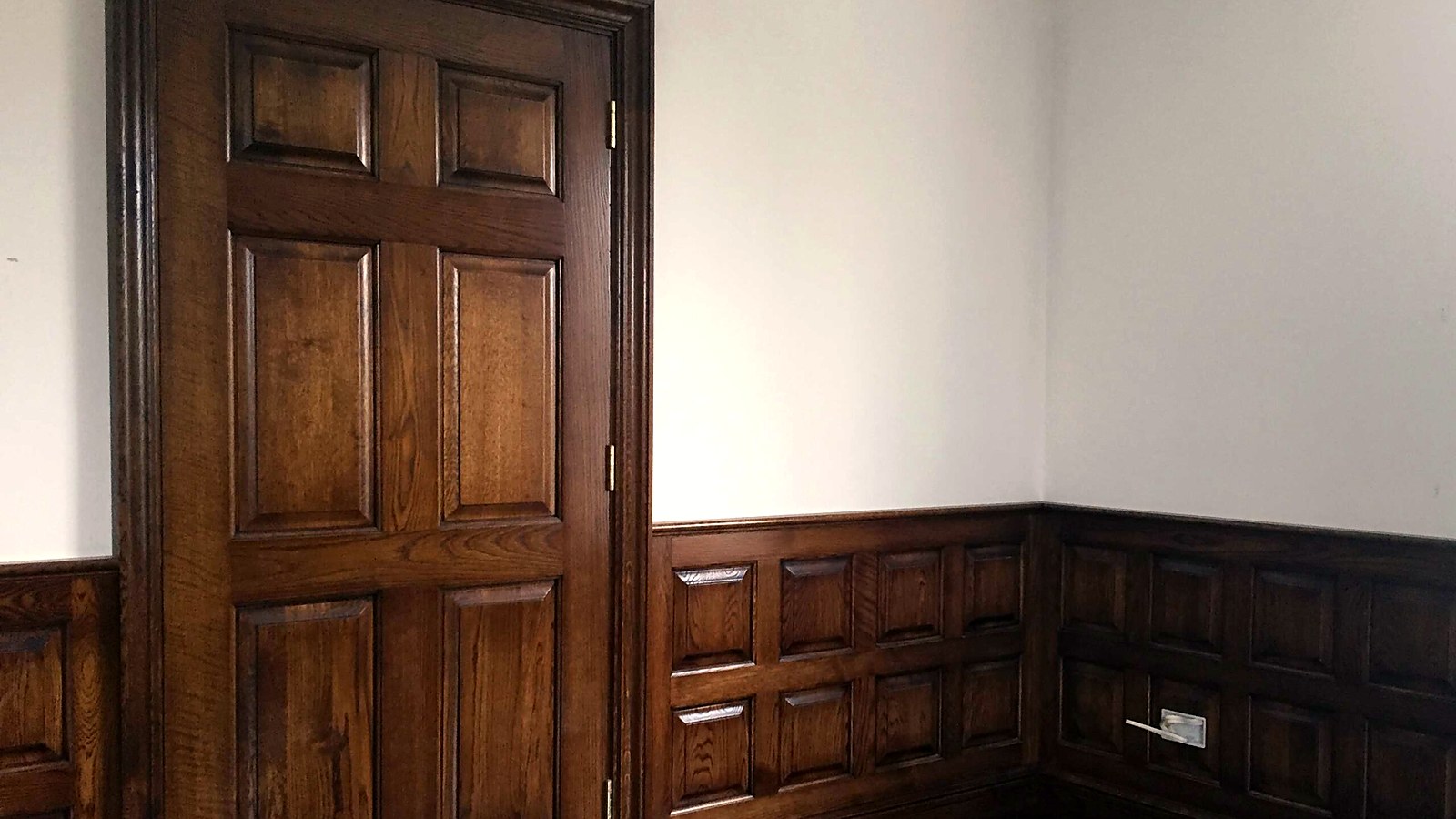
The third approach is the dedicated media or cinema room, where the joinery is a complete interior – wall panelling, acoustic treatment within the furniture frame, concealed projector housing, fitted seating surrounds and integrated lighting. The room exists for the technology but does not look like a shop floor. We have designed and made a number of private home cinema interiors for London clients and country-house projects where a dedicated media room is part of the wider renovation brief.
Materials and finishes
Painted hardwood
The most common choice for London sitting rooms and reception spaces. Any Farrow & Ball, Little Greene or client-specified colour, hand-sprayed in eggshell or satin finish in-house.
Natural oak
European or American white oak, oiled or lightly lacquered. Suits contemporary open-plan living spaces and rooms where the furniture language is material-led rather than painted.
Walnut
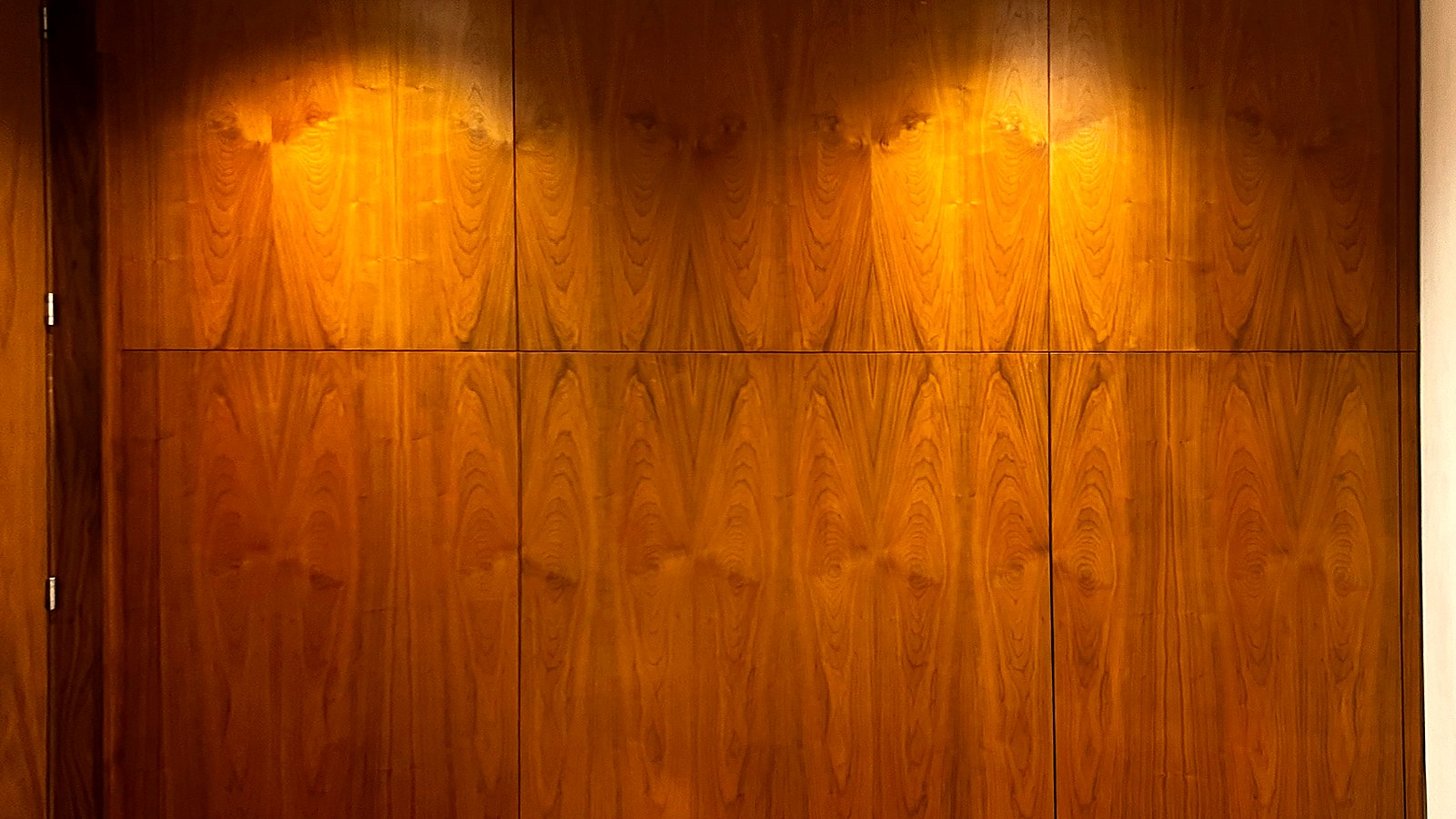
A rich, dark material for formal sitting rooms, private media rooms and townhouse reception spaces. Walnut media cabinetry reads as serious furniture.
Lacquered finishes
A hardwearing alternative to paint for high-traffic door faces and shelves. Available in a full range of tones, from near-gloss to satin.
Integrated lighting
LED strip lighting behind the screen for bias lighting, recessed spotlights in the cornice detail, and display lighting for shelved objects – all resolved at the drawing stage.
Hardware and mechanisms
Soft-close doors and drawers, motorised TV lifts, cable-managed pull-out AV shelves, solid brass or steel handles, and push-to-open mechanisms for flush-front cabinetry.
Recent TV and media joinery projects
Choosing the right design for your room and screen
Screen size has a significant bearing on the design of the media joinery. A 55-inch screen can be concealed behind a pair of hinged cabinet doors without difficulty. An 85-inch screen requires different thinking: the doors become unwieldy at that scale, and a framed recess with the screen as an acknowledged feature of the room is usually the better design solution. For very large screens – 100 inches and above – the screen often becomes the wall, and the joinery frames it on either side with closed storage, integrated lighting and flanking shelving.
Viewing height is a separate consideration. The correct height for a television screen is determined by eye level when seated – typically with the centre of the screen at or just below seated eye height (approximately 1,050-1,100mm from floor level). Many media units place screens too high, which causes neck discomfort and reduces the quality of the viewing experience over time. We position screens at the correct height as part of the design drawing, not as an afterthought once the cabinet has been built.
Where we work: media joinery across London and the Home Counties
TV and media joinery commissions are accepted across London – including Kensington, Chelsea, Notting Hill, Belgravia, Mayfair, Islington, Hampstead and Marylebone – and across the Home Counties for the right residential projects. We also work in East Anglia and take UK-wide commissions where the standard of finish required is consistent with bespoke workshop making.
Media joinery is frequently part of a wider fitted furniture programme. A sitting room commission might include the media wall, a pair of alcove bookcases, wall panelling and a fitted drinks cabinet – all designed as a single coordinated interior. We are experienced at managing and delivering these wider programmes, and at co-ordinating the joinery with other trades including plasterers, electricians, AV installers and decorators.
Return to the fitted furniture overview or explore related services: alcove and fireplace joinery, timber wall panelling and fitted wardrobes.
TV and media joinery FAQs
Can the TV be hidden when not in use?
Yes. We make media cabinets with hinged or sliding doors that conceal the screen when not in use, and we can incorporate motorised TV lift mechanisms into a base cabinet or chest. The solution depends on the size of the room, the screen size and the brief.
Do you co-ordinate with AV installers?
Yes. We work alongside the client’s AV installer from the drawing stage. Cable routes, equipment bay sizes, ventilation requirements and access hatches are all specified in relation to the AV system being installed. This is far better than designing the joinery first and adapting the AV installation to fit afterwards.
Can you include surround-sound speaker positions within the joinery?
Yes. Speaker housings, grille-covered bays and in-wall speaker access can all be incorporated within a media wall design. We co-ordinate with the acoustics consultant or AV designer on the dimensions and positions required.
Can a media unit be combined with an alcove bookcase?
Yes. The combined media and bookcase unit – flanking a chimney breast, with the TV positioned centrally above the fire opening or in a dedicated recess – is one of our most common commissions. See our alcove joinery page for more on chimney-breast solutions.
How long does a fitted media unit take?
A single fitted media unit or media wall typically takes six to ten weeks from drawing approval to installation. Larger combined schemes with panelling, bookcase flanks and integrated lighting take longer. We confirm a timescale when we quote.
Discuss a TV and media joinery commission
Send photographs of the room, the screen size, the AV equipment list and any design references. We will assess the options and outline the design and making process.
Tv media bespoke by Reeve & Co
From our Suffolk workshop we design, make and install tv media bespoke for high-end homes across London, the Home Counties and East Anglia. Every commission is made to measure and finished to a furniture-quality standard. To discuss tv media bespoke, get in touch or explore our case studies.